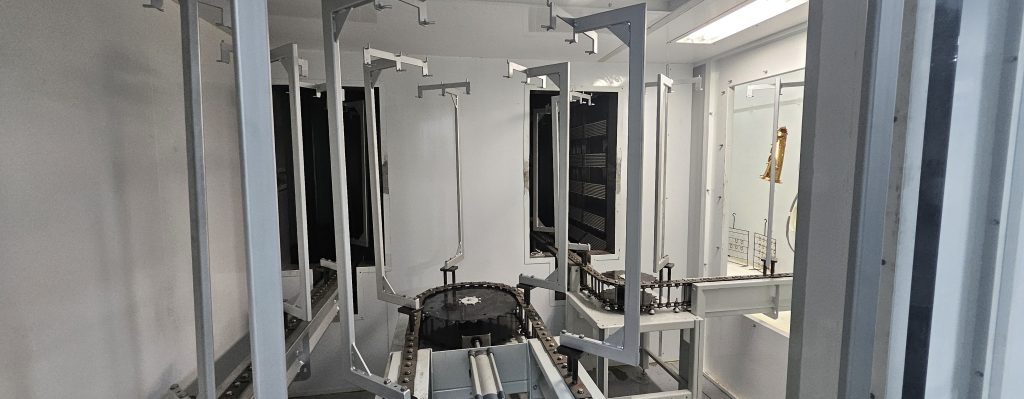
Industrial curing and drying oven
Reaching temperature and holding it, for as long as it takes. To dry, bake or cure after application — part by part or on a conveyor.
A curing oven — or drying oven — brings the painted part up to temperature to speed up drying, or to cure a powder coating. It is not an accessory: in a surface treatment line, it is very often the oven that sets the pace of the entire workshop.
An undersized oven becomes the bottleneck of the whole installation. A correctly sized oven with poor temperature distribution produces unevenly baked parts, which only shows up in use.
Drying or curing: two different needs
The two look alike from a distance but do not have the same requirements.
Drying liquid paint works at moderate temperatures, in the region of 60 to 70 °C. The aim is to speed up solvent evaporation and the setting of the film without stressing it. This is the function performed by the curing mode of a paint booth.
Curing a powder coating is a completely different regime: 180 to 200 °C depending on the powder, with a temperature/time combination set by the powder manufacturer. Here, the oven does not just speed up a natural process, it triggers a reaction. If it does not hold the value across the whole load, the powder does not adhere durably.
What determines the sizing
- The mass to be brought up to temperature, not the volume. A heavy part does not reach the set point at the same rate as thin sheet metal: it is this gap that has to be paid for in the sizing.
- The target throughput, which determines whether you need a batch oven or a tunnel built into a line.
- The temperature uniformity required at every point of the load, not just at the set point.
- The heating method and the energy available on site.
- Handling: trolleys, hangers, overhead conveyor, or floor loading.
- Insulation and heat recovery, which account for most of the running cost over the service life.
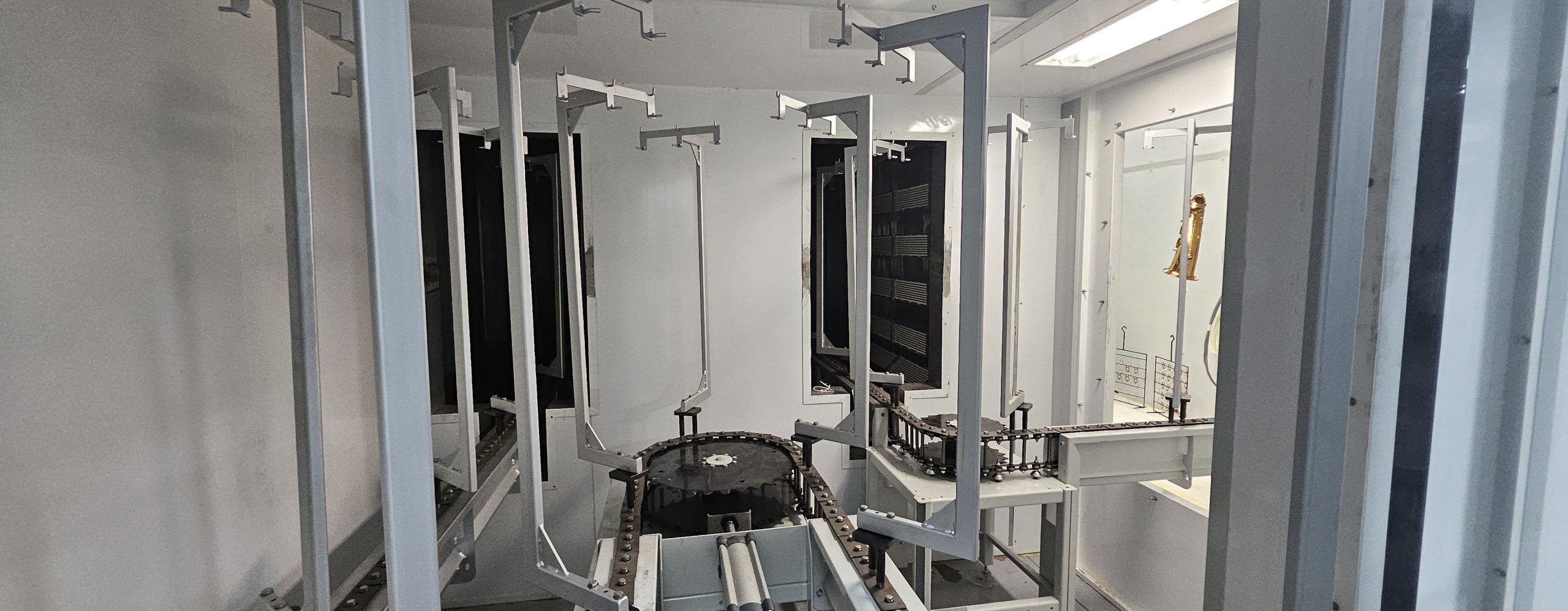
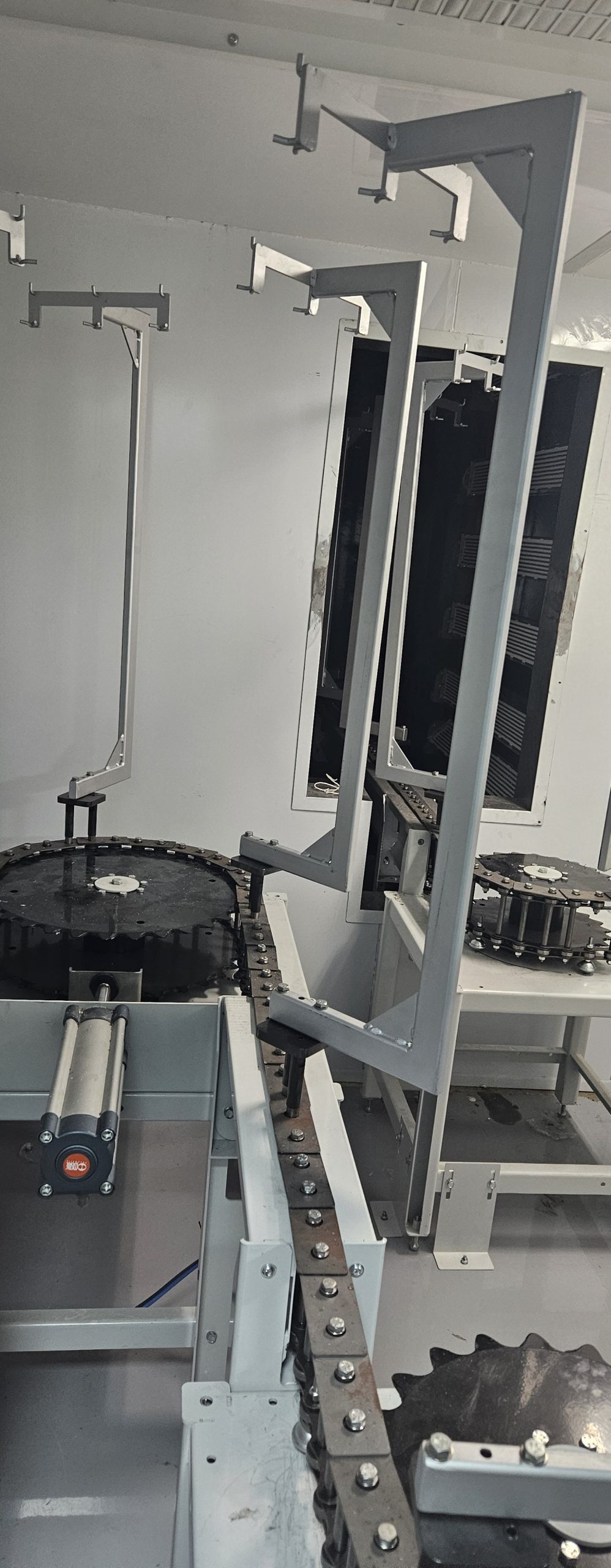
Stand-alone oven, or combined booth
Many workshops do not need a separate oven. A paint booth fitted with a curing mode paints and then dries in the same enclosure: it is the most compact layout, and the most economical as long as throughput stays moderate.
A dedicated oven becomes necessary when drying becomes the limiting factor — because it ties up the booth when the next part could already be painted — or when the process requires a temperature the booth cannot hold, which is always the case with powder coating.
The calculation is simple to set out: if your booth spends a large share of its time drying rather than painting, a separate oven frees up capacity you have already paid for.
Frequently asked questions
At what temperature does liquid paint dry?
In the region of 60 to 70 °C for standard curing. Above that, you do not save time proportionally and you risk stressing the film. The figure that counts is the paint manufacturer’s, not a general value.
And for a powder coating?
Between 180 and 200 °C depending on the powder and the thickness. The powder manufacturer specifies a temperature/time combination to follow, and it is this combination that the oven must hold across the whole load.
Is an oven essential for powder coating?
Yes. Curing is an integral part of the process: without it, the powder does not harden and does not adhere. This is what most clearly distinguishes powder coating from liquid paint.
Can a curing oven be added to an existing installation?
Yes, in fact it is a frequent request when the booth becomes the bottleneck. The study then looks at the space available, the energy and above all the handling between the two stations, which is often the real issue.
Need drying or curing?
Describe your parts, their mass and your throughput: we will size the right curing oven, stand-alone or built into your installation.


