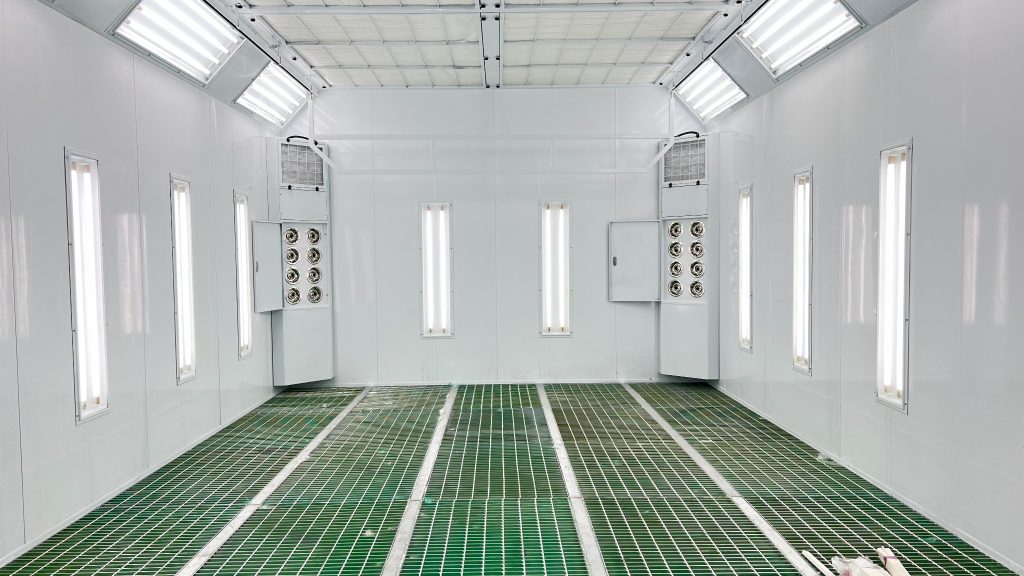
Paint booth for the railway sector
Rolling stock poses a problem that is simple to state: it is long, it is heavy, and it cannot be turned over.
A rolling stock carbody is a difficult object for a booth, and for a reason that has nothing to do with paint: its length. Where an ordinary part can be turned so the right side faces the painter, a carbody stays where it is. It is the operator who moves, along its entire length.
That shifts the problem. What matters is no longer the volume of the enclosure but consistency along its entire length: the same lighting at the start and at the end, the same airflow, the same temperature. A badly designed long booth paints well in the middle and badly at the ends.
What length changes
Making a booth longer is not the same as scaling it up. Three variables stop behaving the way they do in a short enclosure, and each one is dealt with at the design stage.
Air
an airflow that comes down correctly in the centre can weaken at the ends. Over a long length, air distribution is designed section by section, not from a single point
Light
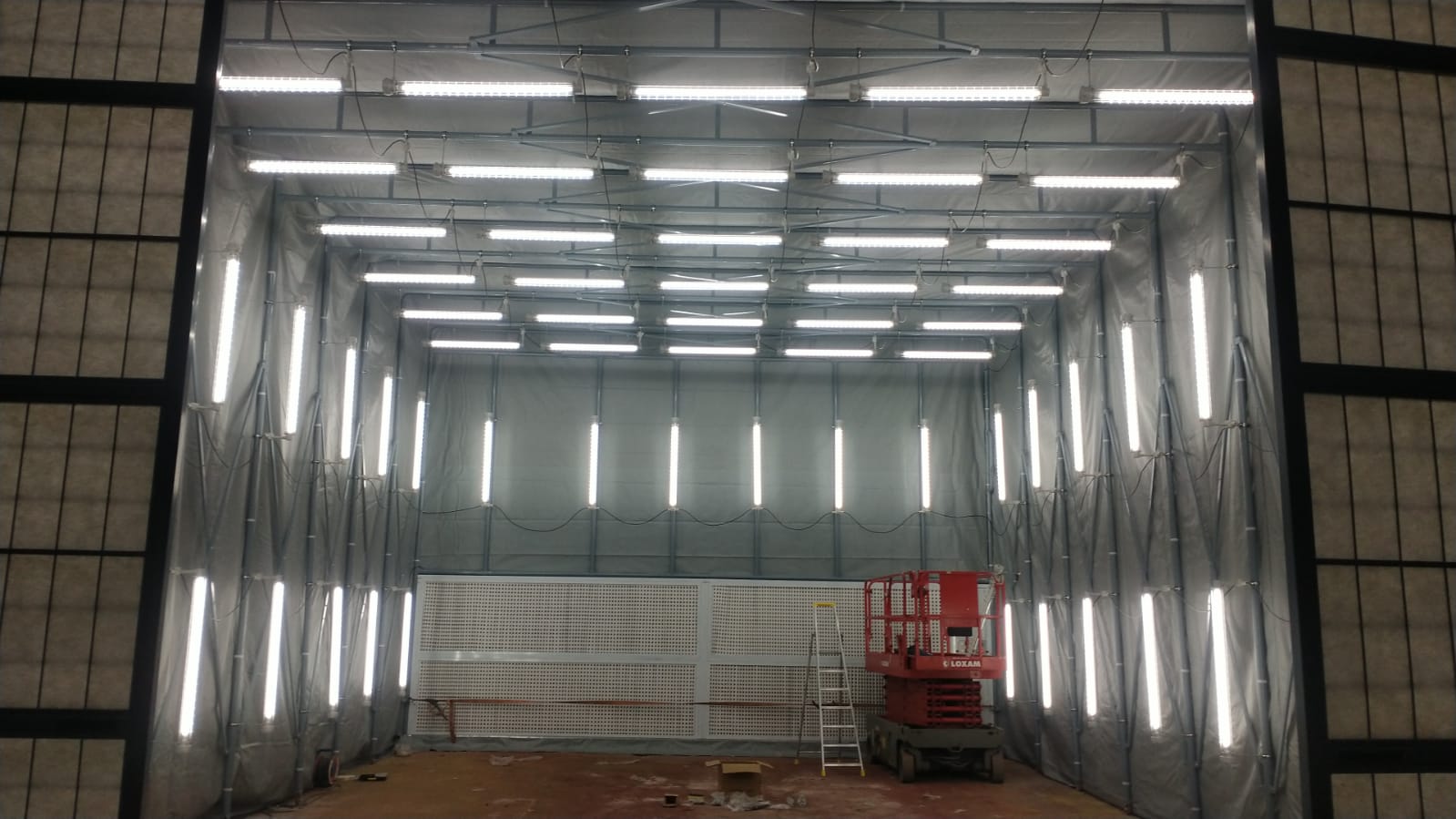
judging a colour requires the same lighting everywhere. A long carbody shows up the slightest difference between two zones, and those differences show on the finished result
Temperature
warm air does not spread evenly over twenty metres on its own. Without a properly designed air return, one end dries while the other is still waiting
Access at height
a carbody is also painted on the roof and on the upper sides: walkway, platform or clear height for an aerial work platform are decided beforehand, not afterwards
What we know how to do
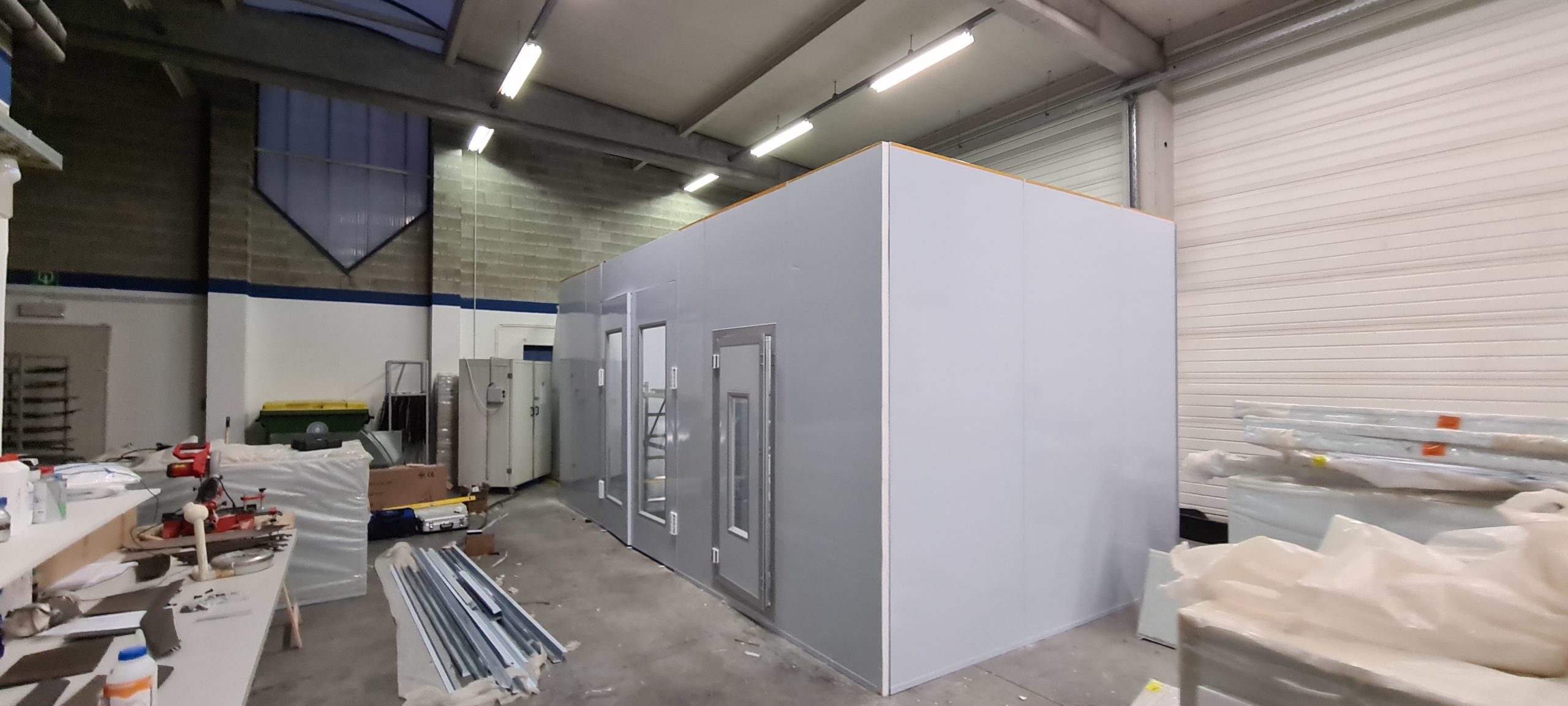
We design and build custom enclosures, with no standard dimensions, in our own workshop. We install our own systems and dismantle others, including those built by other manufacturers — which is a good school for learning what ages badly.
From the enclosure’s point of view, a rolling stock carbody is a very long part that is not easy to move. Length, access, and consistent airflow and lighting do not change in nature from one sector to another: they are the same questions as for a large machine or a marine part, asked on a different size.
We have worked in the railway sector. We do not describe that project here — when a client allows us to, we show it; the rest of the time, we would rather say nothing than tell stories.
Frequently asked questions
What we are asked about very long enclosures.
Do you have references in the railway sector?
Yes. We do not detail them publicly: not all our clients allow us to communicate about their installations, and we would rather say nothing than tell half the story. We are happy to talk about them in a conversation. Our projects also cover industry, marine, large machinery and bodywork.
How long can you go?
The enclosure is built to the size you need; it is your building and your budget that set the limit, not our catalogue. The height under the roof trusses and the spacing of the columns are almost always the hard constraints, before the length itself. That is why the building survey comes before any pricing.
How does the part get into the enclosure?
This is often what sizes the installation, more than the painting does. Through track, end doors, removable façade: the solution depends on how the part arrives and what it has to do next. When nothing allows permanent access, a retractable booth is set up around the part and then folded away.
Can an enclosure this size be heated?
Yes, but it cannot be improvised and it is a cost item in its own right. The volume to be heated grows quickly with length, and even distribution requires several supply and return points. It is one of the first trade-offs in the study: heating the whole enclosure, or only the working area.
A part too long for an ordinary booth?
Give us its dimensions, how it arrives, and the height under the roof trusses of your building. We will tell you frankly whether the project is feasible at your site, and on what conditions.


