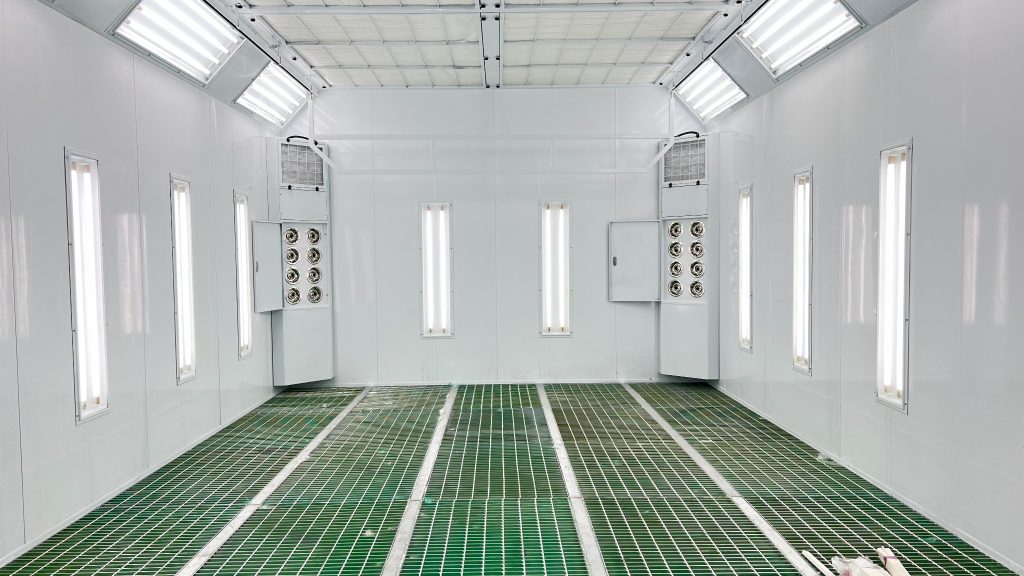
Paint booth with curing up to 150 °C
A paint booth usually goes up to 80 °C. Ours go up to 150 °C — and apply the paint in the same enclosure.
Above 80 °C, a paint booth changes in nature. It is no longer about drying a finish but about baking: curing a technical coating, or completing the cure of a composite part. Most booths on the market stop short of that, because body shops don’t need it.
We build booths that go up to 150 °C, and in which the paint is also applied. A single enclosure does both jobs: the part is not moved between application and curing.
A booth, not a curing oven
The two are often confused, and that mistake is expensive at the time of purchase, so let’s clear it up straight away.
A curing oven only brings a part up to temperature. Nothing is applied in it: the part arrives already painted or already laminated. It is an oven, and that’s perfectly fine for what it is.
A 150 °C paint booth does both. The product is applied in filtered, controlled air, then the temperature is raised without taking the part out. You don’t handle a freshly coated part, and you don’t have two machines to install, connect and maintain.
The curing oven
it heats, it doesn’t apply. The part goes in already treated.
The standard booth
it applies and dries, up to about 80 °C. That’s all a body shop needs.
The high-temperature booth
it applies and cures, up to 150 °C, in the same enclosure.
What a slow heat-up changes
At these temperatures, the maximum value isn’t the real issue. What matters is how you get there.
A composite part or a technical coating is cured according to a cycle: a gradual heat-up, a hold, a cool-down. Heating too fast creates temperature differences through the thickness of the part — and those differences are paid for in defects, not in minutes saved.
That’s why a high-temperature booth is not just a more powerful burner. It needs insulation that holds the heat, controls that follow the set point, and air distribution that doesn’t leave one corner hotter than another.
Who it’s for
It isn’t a body shop need. It’s a technical workshop need, and a specific one.
Composite parts
curing and post-curing resins require temperatures and cycles that standard booths don’t reach
Technical coatings
anti-corrosion, high-resistance, products whose technical data sheet requires curing above 80 °C
Workshops with no room for two machines
a single enclosure replaces the booth and the oven, with one connection and one extraction system
Parts you’d rather not handle
those that come out of application fragile, and that a transfer to an oven would damage
Always custom-designed
There is no catalogue model at 150 °C, and there can’t be. The target temperature, the cycle to be held, the type of parts and their weight determine the insulation, the power and the controls.
So we start from your process: what you apply, onto what, with which cycle, and at what throughput. The building survey comes next — the power supply and extraction of a high-temperature booth are not those of an ordinary booth.
Frequently asked questions
What we are asked before starting a high-temperature study.
What is the difference between a 150 °C booth and a curing oven?
The curing oven only heats: the part goes in already painted or already laminated. The high-temperature booth applies the product in filtered air, then raises the temperature without the part coming out. One enclosure, one connection, and no transfer of the part between application and curing.
Why do paint booths usually stop at 80 °C?
Because body shops don’t need more. Automotive paint dries well below that, and pushing the temperature higher would cost insulation and energy for nothing. The need arises elsewhere: composites, technical coatings, products whose data sheet requires curing.
Is the temperature rise controlled?
It’s the central technical point. A curing cycle is a gradual heat-up, a hold, a cool-down. Heating too fast creates temperature differences through the thickness of the part, and those differences are paid for in defects. Insulation, controls and heat distribution therefore matter as much as the maximum temperature.
Can it also be used as a normal booth?
Yes. It applies paint in filtered air like any enclosed booth. High temperature is an extra capability, not an exclusive mode.
Is there a catalogue price?
No, and it would be dishonest to display one. Each high-temperature installation is designed around your process: target temperature, cycle to be held, type and weight of parts, throughput. These are what determine the insulation, the power and the controls — not a standard format.
Do you work on existing installations?
We look into it, but it’s rarely simple: converting a booth designed for 80 °C to high-temperature use affects the insulation, the heating and the controls. The survey will tell whether the conversion is reasonable or whether a new installation costs less.
Need curing above 80 °C?
Tell us what you apply, onto which parts and with which cycle. We’ll tell you frankly whether a high-temperature booth is the right answer, or whether a separate curing oven would cost you less.


