Compare our paint booth ranges
Enclosed, open, retractable, truck, custom-built. Plus curing ovens, extraction walls and complete lines.
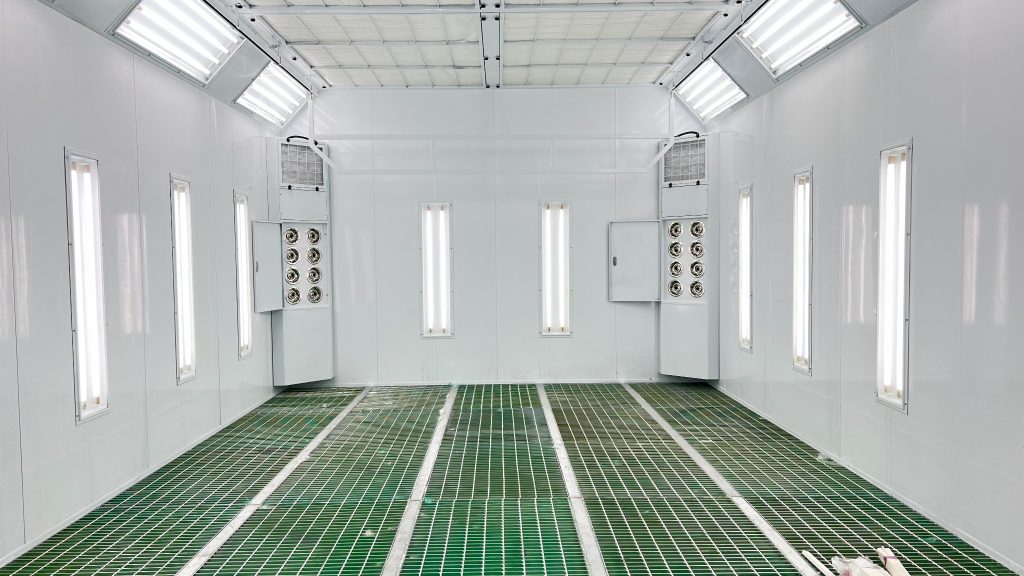
A paint booth is an enclosed, ventilated space, kept under slight negative pressure as the standard requires: air is filtered on the way in, then extracted downwards, carrying the overspray mist with it. That is what gives a dust-free finish and protects the operator.
We build the entire range — from the standard-size body shop booth to oversized installations — and we handle installation, commissioning and maintenance all over the world; our main markets are France, Belgium and Luxembourg.
Our paint booths
Each family addresses a different constraint. If you’re unsure, the useful question isn’t ‘which one is best’ but ‘what am I painting, in which building, at what throughput’.
- Automotive paint booth — body shops and cars, filtered and heated air, a finish with no rework
- Retractable booth, also called foldable; mobile option (on castors) for small sizes — folds away to give the floor space back to the workshop between jobs
- Open booth — primer, touch-ups and bulky parts, without enclosing the space
- Extraction wall — a filtering wall facing the operator, the lightest layout
- Truck booth — trucks, semi-trailers and construction machinery, extra height and suitable access
- Industrial booth — sustained throughput, integration into a production line
- Joinery and cabinetmaking booth — lacquering and varnishing wood, long parts
- Powder coating booth — powder paint, recovery and oven curing
- Paint mixing room — preparation and colour matching, ventilated and compliant
- Custom-built booth — when no catalogue size fits
How to choose
Five questions are enough to steer a project. They are listed in the order in which they really matter.
- What do you paint? The most awkward part determines the working dimensions, not the most common one.
- At what throughput? Daily use justifies an enclosed, heated booth. Occasional use points towards a retractable one.
- What finish quality? Visible bodywork calls for an enclosed booth, with filtered incoming air. For primer, an open booth is enough.
- What building? Ceiling height, structure, floor, options for exhausting air. Many projects are decided here, and it’s better to find out before the study.
- What handling? Overhead crane, conveyor, heavy parts: this is often what decides the layout.
What makes the difference in use
Two booths of identical dimensions can give very different results. The gap comes down to three points, rarely highlighted at the time of purchase.
Ventilation first. The NF EN 16985 standard requires, in vertical airflow, a minimum of 0.25 m/s at every measuring point and an average of 0.3 m/s. An installation can show a correct average while leaving dead zones: that is where finish defects start.
Filtration next, over four stages, each of which passes its load on to the next if it is neglected. We fit G3 / F5 in the standard configuration, and any class on the market if the specification requires it — up to F10 on an aerospace project.
Motor sizing last, which must be calculated on the actual extraction area: vehicle or part in place, not an empty booth.
Beyond the booth
- How a paint booth works — how it works in detail, step by step
- Curing and drying ovens — drying liquid paint and curing powder coatings
- Our projects — the sectors we have equipped and how far we have gone
- Filters and maintenance — consumables and service work, all makes
- Installation and dismantling — installation, relocation and refurbishment
Frequently asked questions
What is the standard size of an automotive paint booth?
The most common size in body shops is around 6 × 4 m of working area, which takes a car with the space needed around it to work. It isn’t a standard: the right size is the one that leaves the operator room to move around the bulkiest part you handle.
Do you need civil works to install a booth?
It depends on the model. A conventional enclosed booth usually needs a pit or a plenum, and therefore building work. A retractable booth or an extraction wall can usually be installed without civil works, which is precisely their advantage when the floor can’t be touched.
What is the difference between a paint booth and a paint room?
They are two names for the same equipment; ‘booth’ is the term used in the trade. A ‘paint mixing room’, on the other hand, is the station dedicated to preparation and colour matching, which is a separate piece of equipment.
Do you work on a booth you didn’t build?
Yes: supply of filters, replacement of motors and fans, diagnosis of extraction loss, compliance audits, installation, dismantling and relocation, whatever the make.
Which regions do you work in?
We work all over the world, for design as well as installation and maintenance; our main markets are France, Belgium and Luxembourg.
A paint booth project?
Tell us what you paint and in which workshop. We’ll steer you towards the right configuration, without selling you anything bigger than you need.


