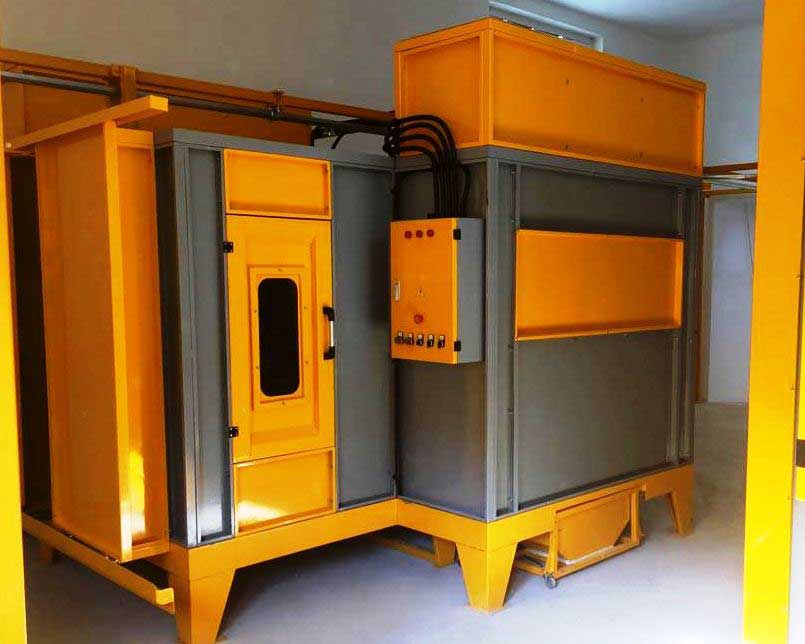
Industrial powder coating booth
Powder coating booths and curing ovens, up to the complete line with powder recovery.
Powder paint is not handled like liquid paint. It is applied by electrostatic spraying onto an earthed part, then cured in an oven. Powder that has not stuck is not lost: it is recovered and reused.
That difference dictates all the equipment. A powder coating booth is not an adapted paint booth: it is designed around powder recovery and control of the electrostatics.
Why powder coating
- No solvent: the constraints linked to volatile organic compounds disappear
- Oversprayed powder is recovered and reused, which greatly reduces material losses
- High film thicknesses in a single pass
- Good mechanical and corrosion resistance on metal parts
- A process that lends itself well to automated series production
What an installation includes
A powder coating installation is made up of several elements that have to be sized together. Taking the booth on its own without thinking about the oven or the recovery almost always leads to a bottleneck.
- The powder coating booth, with its recovery system
- The curing oven, sized to your parts and your throughput
- The surface pre-treatment: degreasing, washing, preparation
- Handling: conveyor, hangers or fixed stations depending on volumes
- The colour change system, decisive if you switch colours often
The process in figures
Powder coating is compared on precise values. It is worth having them in mind before putting two quotes side by side.
- Curing between 180 and 200 °C, depending on the powder and the target thickness. The temperature/time combination is given by the powder manufacturer: what matters is that the oven holds this value across the whole load, and not only at the set point.
- More than 95% recovery of the oversprayed powder, with a properly maintained cartridge system. It is this rate that makes powder coating so economical compared with liquid paint: whatever has not stuck goes back into the circuit.
- Colour change dictates the configuration. Fully cleaning the circuit determines the downtime between two colours — it is the first question to ask yourself if you switch often.
Manual station or automated line
A manual station suits short runs, varied parts and frequent colour changes. The operator stays in control of complex shapes that no robot handles well.
An automated line becomes profitable as soon as runs get longer and parts are similar. It brings consistent thickness and throughput, at the cost of less flexibility.
Many installations combine the two: a line for volume, a manual station for touch-ups and special parts. It is often the most profitable configuration.
Frequently asked questions
What is the difference between powder coating and liquid paint?
Powder coating applies a powder electrostatically, without solvent, then cures the part in an oven. Oversprayed powder is recovered. Liquid paint is applied in solvent-based or water-based form and dries without always needing an oven.
Can anything other than metal be powder coated?
The process relies on earthing the part and on a pass through the oven: so it is mainly intended for metal parts able to withstand the curing temperature. Tell us about your parts and we will tell you what can be done.
Do you need an oven as well as the booth?
Yes. Curing in the oven is an integral part of the process: without it, the powder does not adhere durably. The oven is sized to your parts and your throughput.
At what temperature does the powder cure?
Between 180 and 200 °C depending on the powder used and the thickness required. The powder manufacturer specifies the temperature/time combination to follow; the oven’s job is to hold it across the whole load. A heavy part does not heat up at the same rate as thin sheet metal, and it is this gap that has to be paid for in the sizing.
How much of the powder is actually recovered?
More than 95% of the oversprayed powder, with a properly maintained cartridge system. The key word is “maintained”: a clogged system loses recovery efficiency before showing any other symptom.
Is colour change complicated?
It is the sensitive point of powder coating. The more you switch colours, the more decisive the recovery and cleaning system becomes. We take this into account from the study stage, based on your actual number of changes.
A powder coating project?
Describe your parts, your runs and your colour changes: we will design the installation that suits them.


