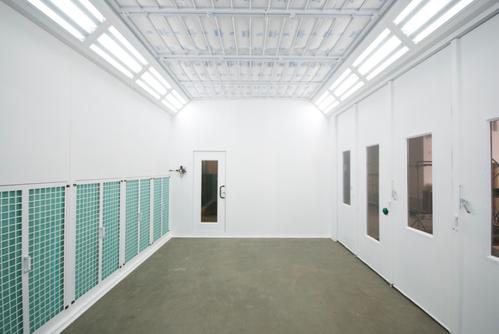
Paint booth for woodworking and cabinet making
Long parts, lacquering and varnishing: the constraints of wood are not those of bodywork.
Mecatelier designs and installs paint, varnishing and lacquering booths for joinery workshops, cabinet makers, interior fit-out workshops and furniture manufacturers.
Applying a finish to wood has little in common with automotive painting. The parts are long, often flat, sometimes fragile; the products range from varnishes to lacquers, by way of stains and sealers; and the main enemy is not metal sanding dust but wood dust, which is everywhere in the workshop. A booth designed for bodywork cannot be carried over as it is.
Varnishing and lacquering booth
Varnishing, lacquering, staining, sealing: these finishes need clean air and a controlled airflow; otherwise the slightest airborne dust gets trapped in the film and forces a complete rework.
The booth separates the workshop — where you sand and machine — from the finishing area. It is this separation, more than the equipment itself, that determines the quality of the result.
Enclosed, open-front, or just an extraction wall
Three ways of handling the same part. The difference costs money, and it is justified — or not.
What changes compared with an automotive booth
- Dimensions suited to long parts: doors, worktops, fit-out panels
- Handling designed for flat parts, on trolleys or trestles, rather than for a vehicle
- Treatment of wood dust, produced upstream and much finer than bodywork dust
- Compatibility with a variety of products: varnishes, lacquers, stains, water-based or solvent-based products
- Drying that respects the material: wood moves, it does not react like sheet metal
Where the air goes
On a door laid flat, the direction of extraction decides the finish. Three options, three different sets of building work.
The fumes, and the people working in them
A varnish or a lacquer does more than smell. The fumes released during application are breathed in all day long, and that is the main reason a woodworking shop equips itself — even before finish quality.
Correctly sized extraction removes them as they are released, instead of letting them linger and spread through the workshop. Nor does the product mist settle on finished parts placed nearby.
This is also what sets an extraction wall apart from a simple wall-mounted extractor: the former captures in front of the workstation, where the product is sprayed.
What is included, and what is not
Only two items remain price on request, and for a reason: nobody can price them without coming to see.
Travel costs are added, depending on distance.
Included
the booth, delivery, and installation by our teams. You do not receive pallets to sort out yourself
Price on request, after a site survey
the duct that exhausts the air outside, and floor works if any are needed. Two items that depend entirely on your building
Financing
lease with option to purchase available, with no mandatory down payment, based on your last two balance sheets. We state the capital; the finance company states the monthly payment
What it costs to run
Everyone asks about the purchase price. What really decides is what comes afterwards.
In wood finishing, the main expense is not the same as in bodywork: you heat less, but often for longer. A varnished part occupies the booth until it is dry, and it is that time that costs — in energy and in space.
Heating
during application, the booth exhausts air outside and therefore heats fresh air continuously. This is the big cost item
Drying
this is what frees up the booth. With water-based products, drying assistance changes the throughput: we will tell you whether your volume justifies it
Maintenance
it depends on your hours of use, not on the calendar. We price it on your actual use rather than selling you a flat rate that matches nothing
Comparing two quotes without getting caught out
Every manufacturer states an airflow. The figure looks comparable. It almost never is.
Three questions to ask, the same ones to everyone. If a salesperson dodges any of the three, you know why.
The full calculation, with the value required by the standard, is set out plainly in the FAQ below. Enough to check any quote, including ours.
“What floor area is this airflow calculated on?”
empty booth or parts inside: it is not the same figure. Some offers look cheaper simply because they count a smaller area
“Is that the fan’s airflow, or the one I will actually get?”
with filters that are starting to clog, the second one drops. That is the one that matters to you
“And at the back, behind the part?”
a door laid flat acts as a screen. A booth can show a good average and blow too little where you are working
Filters, and why your finish depends on them
Three barriers between the dust and your part. In joinery, the first one matters more than elsewhere: wood sanding dust is fine, light, and already in the workshop before you even enter the booth.
Any filtration class on the market can be fitted, by adjusting the motor pressure. If you work for a demanding customer, say so when we price the job: it is planned at the design stage, not afterwards.
At the air inlet
stops coarse dust before it wears out the fine filter. It is the cheapest of the three, and it protects the other two
In the ceiling
this is the one that decides your finish. When it reaches the end of its life, it shows on the part before it shows on a gauge
At the extraction point
in the floor or in a wall depending on the direction of extraction, it catches the product mist before it goes into the duct
Which workshops
We equip joinery workshops looking to move finishing out of their production area just as much as fit-out companies whose volumes justify a properly sized installation.
Each booth is designed around your most demanding parts, the space available and your actual throughput — not around a standard catalogue.
- Joinery and cabinet-making workshops
- Interior fit-out workshops and furniture manufacturers
- Door, window and staircase manufacturers
- Restoration and wood finishing workshops
Will it fit in your workshop?
Four things decide, and none of them can be guessed from an office. We always come and measure before pricing.
In joinery, the question is not just “will the booth fit?”, it is “can the part get in and out?”. A 2.40 m door that has to be turned in a cluttered workshop needs more room around the booth than the booth itself.
Getting your parts through
the longest, the widest, and the way it comes in. This decides the opening, and sometimes a second door, so that parts pass straight through instead of turning round
Your floor
this is what decides between vertical and horizontal extraction. A slab that cannot be opened up does not rule out the booth, it changes its type
Where the air goes out
how far do you have to go to exhaust outside? That route is the item nobody can price without coming to see
Your electricity supply
you need three-phase power. If you do not have it, it has to be planned for, and it is better to know straight away
Frequently asked questions
Do I need to dig up my workshop floor?
Not necessarily, and it is the direction of extraction that decides. With vertical extraction, the air leaves through the floor: you need a pit or a raised floor, with a small step at the entrance. With horizontal extraction, the air moves towards a side filter wall and the booth sits on the existing slab, with no masonry work. Diagonal extraction is the compromise when a pit is impossible but you want low-level extraction. The on-site survey decides.
How high can the temperature go?
Above 40 °C, it is possible for two hours at most. Below 40 °C, the temperature can be maintained with no time limit. In wood finishing, you mostly work in the second range: wood moves, and too much heat takes its toll on the part.
Can drying of water-based products be speeded up?
Yes. Water-based products dry more slowly than solvent-based ones, and this is often what limits a workshop’s throughput. Drying assistance is available as an option and shortens this time. The gain depends on the product, the film thickness and your workshop: we do not announce it in advance, we look at it for your case.
What airflow is needed?
It is calculated, not negotiated. The NF EN 16985 standard requires an average air velocity of 0.30 m/s, and never less than 0.25 m/s at any given point. Multiply the floor area of the booth by this velocity, then by 3,600, and you get the airflow in m³/h. The trap, when you compare two offers, is that each one may use a different reference area: ask the question.
What is the difference between a paint booth and a varnishing booth?
The principle is the same: isolate the finishing area and control the airflow. What changes is the product applied and the parts treated. A varnishing booth for wood is sized for long, flat parts, and takes into account the wood dust present upstream.
Can lacquers and varnishes be applied in the same booth?
That is the usual case in joinery. The configuration depends on the products you actually use and their nature: we take this into account during the study.
What size booth for my workshop?
It is determined from your largest parts, the space available and your production rate. We carry out this study before any priced proposal.
Can a second-hand automotive booth be suitable?
Sometimes, but rarely without adaptation. The dimensions are designed for a vehicle, the handling for wheels, and the air treatment for other kinds of dust. We can study taking over an existing booth and adapting it.
Do you work throughout France and Belgium?
Yes, and beyond: we work all over the world, for the study as well as the installation; our main markets are France, Belgium and Luxembourg.
A booth project for your woodworking shop?
Tell us about your parts and your workshop, and we will work out the right configuration.


