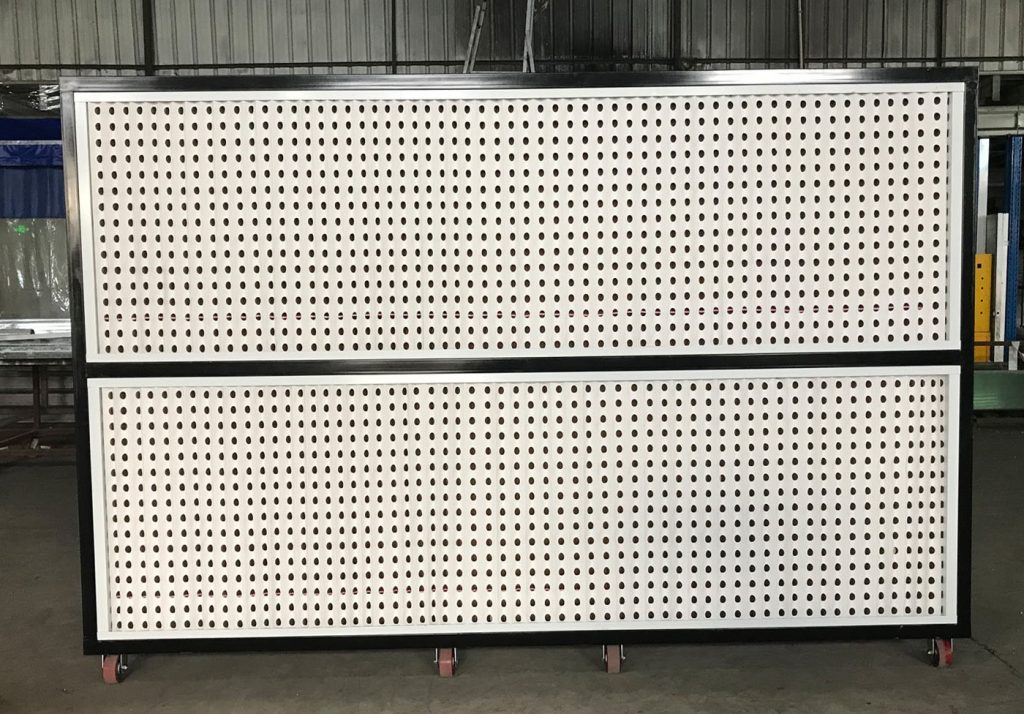
Preparation and sanding areas
Sanding in the booth means wearing out the most expensive equipment in the workshop on the dirtiest job.
Preparation produces most of the dust in a workshop, and it is often done where it should not be: in the booth, because it is the only place that is lit and has extraction.
It is a losing calculation on both counts. The booth is tied up while sanding goes on, its filters load up with dust they were never meant to see, and the remaining dust ends up in the next paint job. A dedicated area solves all three at once.
What a preparation area really does
It is not a cut-price booth. It is a workstation designed for a different job, and so it does not need the same things.
It captures at the source
dust is extracted where it is produced, before it spreads through the workshop and settles on everything lying around
It provides proper lighting
a defect you do not see at the preparation stage shows up after painting, when it costs a complete rework
It does not heat
sanding does not need warm air. That is what makes a preparation area much cheaper than a booth, and much less costly to run
It frees up the booth
which can paint while the next part is being prepared
Preparation area or extraction wall?
Both answer the same problem — capturing what flies around — but not the same working layout.
An extraction wall extracts in one direction: the part is placed in front of it, and the operator works facing the wall. It is simple, compact, and very well suited to parts that can be turned.
A preparation area encloses a space in which you move around the part. It is what you need as soon as the part is bulky or has to be worked on from several angles.
The choice is made on your parts and the space available, not on the budget: chosen badly, the cheapest equipment is the one that goes unused.
What we look at before making a proposal
A preparation area is designed around the real work, not around a theoretical workshop plan.
Your parts
dimensions, weight, and above all how you need to move around them
Your space
a preparation area takes up floor space, and that space is almost always already in use
Your extraction
where the air goes out, and under what discharge constraints
Your workflow
the area must be on the way to the booth, not at the other end of the workshop
Frequently asked questions
What we are asked before fitting out a preparation area.
Why not just sand in the booth?
Because it costs you three times over. The booth cannot paint during that time, its filters load up with abrasive dust they were not designed to hold, and the dust that stays in the air settles on the next paint job. Reworking a finish often costs more than a year of using a dedicated area.
Does a preparation area need heating?
No. In fact, that is what sets it apart from a booth and what makes it affordable: no heater, no burner, no gas or heating oil consumption. The air is treated to capture dust, not to dry a product.
Can it be installed against an existing wall?
That is the most common case, and it is what allows it to be fitted without reorganising the workshop. The on-site survey determines what the wall can take and where the air can go out — it is often the extraction, not the structure, that dictates the layout.
How long is the workshop disrupted during installation?
Much less than for a booth, because there is less to connect: no heating circuit, and simpler extraction. The survey makes it possible to give a firm duration before starting, rather than an estimate that gets revised later.
Is it compatible with a booth from another make?
Yes. A preparation area is an independent workstation: it does not connect to your booth and does not depend on its manufacturer. We regularly work in workshops whose booth is not one of ours.
Is your booth being used as a sanding shop?
If the answer is yes, it is wearing out on a job that is not its own. Describe your parts and your workshop, and we will tell you what a dedicated area would change.


