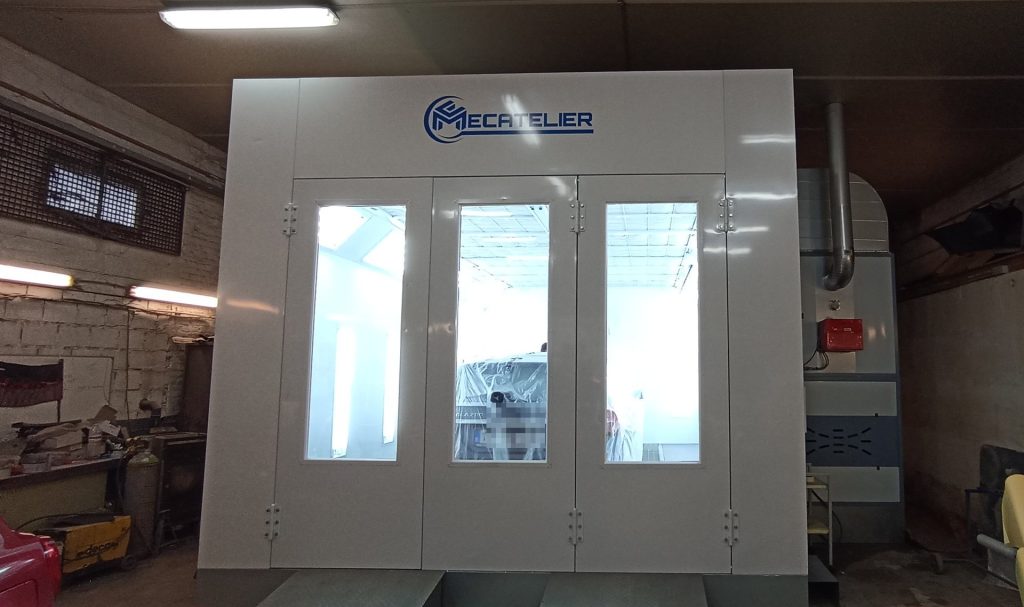
How a paint booth works
Airflow, filtration, heating and drying, explained without jargon. Enough to read a quote and ask the right questions.
A paint booth works in two phases. In the spraying phase, outside air is drawn in, heated, filtered, then let in through the ceiling; it passes through the booth from top to bottom, carrying the paint mist with it, before being filtered again and extracted through the floor. In the drying phase, the booth switches to a closed circuit and rises in temperature to speed up curing.
Everything else — dimensions, doors, burner, lighting, foundations — follows from these two phases. This page goes through each of these elements, in the order in which they matter when you choose your equipment.
The two operating phases
Spraying phase. Air is drawn in from outside by centrifugal motors, then sent to a heat exchanger where it is warmed before being let into the booth through the ceiling. It is filtered four times along the way: by the pre-filters at the motor inlets, by the ceiling filters as it enters the booth, by the floor filters — or the back-wall filters if the booth stands directly on the floor — and one last time as it passes the extraction motor.
Drying and curing phase. The circuit works differently. The booth runs in a closed circuit and takes back its own air, already warm, to blow it in again, which makes it possible to reach the 60 to 70 °C needed without starting again from cold outside air. This is where most of the energy consumption is decided, and therefore most of the running cost.
The extraction ducts exit through the roof or through a side wall of the building. The discharge height is set by the regulations that apply where you are located.
The airflow diagram, in cross-section
A booth is clean air coming down over the whole floor area. Here is the path it takes in the most common body shop set-up: vertical airflow.
Ventilation: the setting that decides everything
The efficiency of the fan determines how well the booth extracts. Airflow speed depends on two factors only: the booth’s floor area and the power of the motors.
The NF EN 16985 standard sets the framework, and it imposes two values, not one. In a vertical-flow booth — from ceiling to floor — the air speed must reach at least 0.25 m/s at every measuring point, and the average of these points must be equal to or greater than 0.3 m/s. In a horizontal-flow booth, the thresholds rise to 0.4 m/s at every point and a 0.5 m/s average.
This distinction between minimum and average is what separates a compliant booth from one that simply looks good on paper. An installation can show a correct average while leaving zones below the threshold: it is precisely these dead zones that cause finishing defects and expose the operator. Always ask for the point-by-point readings, not just the average.
By default, we size for 0.3 m/s in vertical flow, and we go higher when the specification requires it.
Watch out for a common trap: the figures some suppliers quote are measured with the booth empty. But as soon as a vehicle is inside, the extraction area shrinks and real performance moves away from the catalogue figures. Always ask what basis the value was calculated on.
A properly designed booth has two separate motors — one for air supply, one for extraction — and filters suited to the products actually used. For the operator’s safety, the spray mist must be carried from top to bottom without ever lingering in the booth.
Heating and burner
The burner is selected according to the temperature rise, or delta T: the difference between the temperature of the outside air drawn in and that of the air let into the booth. To get 20 °C in the booth when it is −15 °C outside, the burner must deliver a rise of 35 °C.
In Central and Northern Europe, the usual choice is a system providing a rise of 26 to 27 °C, backed up by a device that can temporarily raise the delta T to 35 °C during the coldest periods.
Heating can be gas, oil or electric. Actual consumption depends on too many factors to be stated in advance: ambient temperature in the building, how often the booth is used, burner power, and how well the booth is insulated.
How the warm air is distributed matters as much as how it is produced. Poor distribution creates temperature differences between areas of the booth, and these differences show up directly in the finish. Air-guiding elements correct this — a more expensive option, but its effect on quality is immediate.
Heat exchanger and energy savings
The heat exchanger warms the incoming air. It is itself heated by the burner, whose combustion fumes are discharged separately so that they never contaminate the air in the booth.
There are two designs. The most widespread uses flue channels in side-by-side vertical slots, where the air flows in a straight line. Other manufacturers place rounded flame tubes above the combustion chamber, in several rows: the air winds its way through them, which increases the exchange surface.
On Mecatelier booths, the incoming air is preheated by the outgoing air. This is what keeps gas, oil or electricity consumption down.
Dimensions, doors and foundations
Dimensions. A 4 m car cannot be painted comfortably in a 5 m booth. Our standard size is 6 m long by 4 m wide, a format that suits the vast majority of vehicles, from city cars to small vans. It is the format of our automotive paint booth.
Doors. Two main options, both thermally insulated. Three-leaf doors are made of steel panels glazed in the centre and close with a handle that operates two locking bars, top and bottom, with seals. The electric roller shutter, located at the top of the booth, rolls down to close the space. In every case, an emergency door opening from the inside outwards is mandatory: you just push it.
Foundations. The best-performing configuration is a concrete channel under the booth, which gives unrestricted airflow. A metal platform recreates this channel and provides equivalent extraction through the floor. Standing the booth directly on the floor is still possible — extraction is then through the bottom of the back wall — with no particular risk, but with lower performance.
Floor. On a metal base or after civil works, the floor is made of grating, with the extraction filters underneath. This is the best-performing solution because it gives the largest extraction area. Two solid strips can be kept for rolling stands on small wheels.
Lighting and insulation
Lighting determines the quality of the work. It must reproduce daylight as closely as possible to give a true picture of how the paint will look.
There are two layouts, and they pull in opposite directions. Placing the lights at an angle between walls and ceiling, plus on the ceiling, lights the whole space with few lights — but takes up the space meant for the ceiling filters, and so weakens extraction. Placing the lights in the side panels keeps the filtration intact but needs more lights, and so more electricity.
Do you have to choose between good extraction and good visibility? We have chosen LED strip lights, which remove the compromise: high lighting performance and much lower consumption.
Insulation. It relies mainly on sandwich panels: an insulating core — polystyrene, polyurethane, mineral wool — between two steel sheets. Some manufacturers also insulate the roof and sometimes the motors to retain heat; this practice is still rare and not always necessary.
Waterborne paint and the Venturi system
Waterborne paint is now the most widely used in body shops. It dries differently from solvent-based paint and needs continuous air movement to remove moisture.
That is the job of the Venturi system, fitted to most of our booths: it keeps the air in the booth constantly moving, which speeds up drying and reduces the electrostatic charge that builds up in the space.
Further reading
This guide explains the principle. The following pages describe our installations, their prices and their maintenance.
- Automotive paint booth — our models, their prices and their installation requirements
- Retractable automotive paint booth — for occasional use or limited space
- Filters and maintenance — filter replacement and servicing, all makes
- Paint booth prices — price ranges by product line and what makes the price vary
Frequently asked questions
What temperature does a paint booth reach?
In the drying and curing phase, the booth rises to around 60 to 70 °C. In the spraying phase, the air is simply brought to working temperature, usually around 20 °C depending on outside conditions.
How do you calculate the ventilation of a paint booth?
The airflow required is simple to calculate: area the air passes through, in m², multiplied by the target air speed, in m/s, multiplied by 3,600. The result is in m³/h. This calculation gives an order of magnitude: real sizing takes account of the configuration, the filters and the ducting, and this calculation alone does not prove compliance. The NF EN 16985 standard gives the thresholds. In vertical flow, the air speed must reach at least 0.25 m/s at every measuring point, with an average equal to or greater than 0.3 m/s. In horizontal flow, 0.4 m/s minimum and a 0.5 m/s average. The speed itself depends on the booth’s floor area and the power of the motors. Beware of values quoted with the booth empty: the extraction area shrinks as soon as a vehicle is inside.
How much energy does a paint booth use?
The burner’s maximum power is the starting point for estimating consumption at full load. In practice, the burner adjusts its power to what is needed and stays off during some phases: actual consumption is therefore lower than continuous use at full power. It remains hard to predict precisely, because it depends in particular on the number of cycles and on working conditions. You can nevertheless estimate an order of magnitude for the energy bill. A heat exchanger that preheats the incoming air with the outgoing air noticeably reduces the bill.
Do you need a concrete pit under the booth?
It is not mandatory. A concrete channel gives the best extraction performance, a metal platform gives an equivalent result, and standing the booth directly on the floor is still possible with extraction through the bottom of the back wall — lower performance, but no risk.
How many filters does the air pass through in a booth?
The air passes through four filtration stages: the first three are the filters mentioned on the automotive page, at the air inlet, in the ceiling, then in the floor or back wall, and the fourth filters the outgoing air as it passes the extraction motor, after the spraying area.
What size of booth for a car?
Our standard format is 6 m long by 4 m wide, suitable for anything from a city car to a small van. A 4 m car in a 5 m booth does not leave enough room to work properly around the vehicle.
What air speed do the regulations require?
NF EN 16985 sets two thresholds that apply at the same time. In vertical flow: 0.25 m/s minimum at every measuring point, and a 0.3 m/s average. In horizontal flow: 0.4 m/s minimum and a 0.5 m/s average. Meeting the average without meeting the minimum is not enough — this is the most common mistake on older installations.
A question about your project?
We study your workshop, your volumes and your constraints before making any costed proposal.


