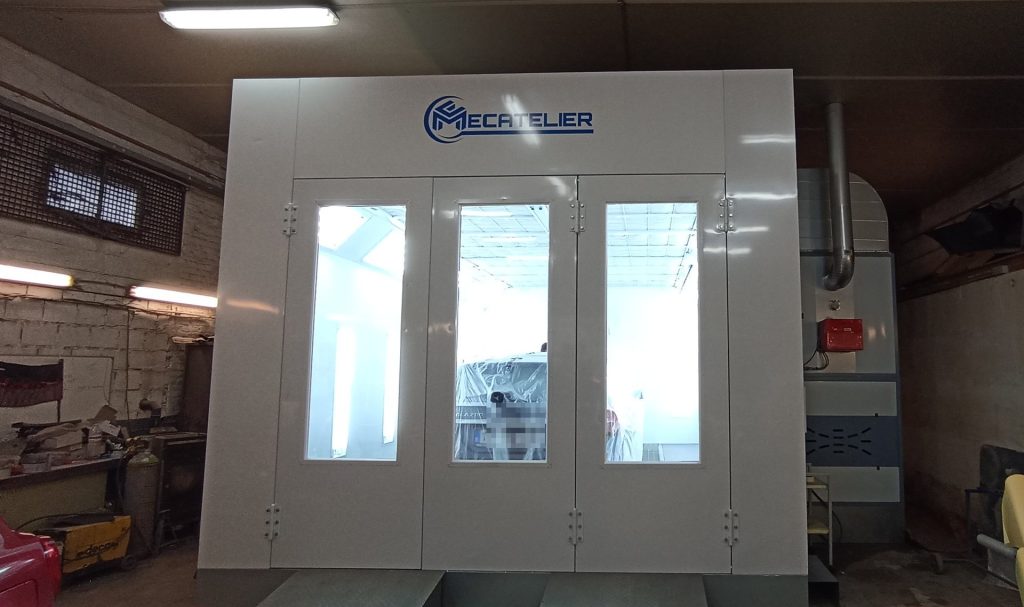
Paint booth for the marine sector
In a marine environment, paint is not a finish. It is what keeps the part alive.
Elsewhere, a paint job that ages badly gets redone. In a marine environment, it lets corrosion set in underneath, and what is at stake is no longer appearance but the durability of the part.
That is what makes this sector demanding on one specific point: sticking to the cycle. An anti-corrosion system is applied in several coats, with recoat intervals to respect between each one. Not too early, not too late — and the enclosure must make it possible to respect them.
What the cycle demands of the enclosure
A part undergoing anti-corrosion treatment occupies the booth for much longer than a bodywork part. That changes what is expected of the installation, and the difference is far from small.
Holding stable conditions for a long time
temperature and humidity must not drift between the first coat and the last, otherwise the next coat is applied in different conditions from the previous one
Speeding up the idle time
waiting between two coats is time the booth is tied up. A controlled drying mode shortens the cycle without compromising the system
Coping with high-solids products
marine primers and epoxies do not behave like an automotive lacquer: more thickness, more overspray mist, more load on the filtration
Realistic filter consumption
it is a running cost to look at when you buy, not when the first invoice arrives
Parts before the hull
Part of marine work is done in the workshop, on sub-assemblies: masts, spars, structures, deck parts, equipment. These parts are long, often slender, and awkward to handle.
They do not call for the same enclosure as a hull. Length is what counts, moving around the part matters more than the total volume, and access at height is often the real issue.
When the part cannot come to the workshop, the enclosure can go to it. A retractable booth is set up around what cannot be moved, then folded away.
Frequently asked questions
What we are asked about installations for the marine sector.
Do you treat complete hulls?
It depends on the size and on what can be moved. A part or a sub-assembly is treated in a workshop booth sized for it. A hull that cannot move calls for an enclosure set up around it, such as a retractable booth. Both exist, and it is the on-site survey that decides — not a catalogue.
Does humidity need to be controlled?
Many anti-corrosion systems require it, and their technical data sheet says so. It is a point to raise from the study stage, because it is not easy to add afterwards: treating air humidity requires equipment sized together with the rest, not bolted on later.
Should sandblasting be planned in the same enclosure?
No, and in fact it should be avoided. Abrasive preparation and paint application have opposite requirements: one produces abrasive dust, the other demands strict cleanliness. Putting them together in the same enclosure means doing both badly, and wearing out the filtration prematurely.
What size of booth do you need?
The size of your largest part, plus room to move around it. On long parts, it is the space for moving around that dictates the sizing, not the raw volume: a booth calculated tightly on the overall dimensions is a booth you cannot work in.
What is the delivery time?
Two to three weeks if the components are in stock, three to four months otherwise. An installation sized for long parts is almost always in the second case: it is built to your dimensions.
What parts do you treat, and with what system?
The dimensions, the anti-corrosion system used and its technical data sheet. That is what we need to size an enclosure capable of holding your cycle.


