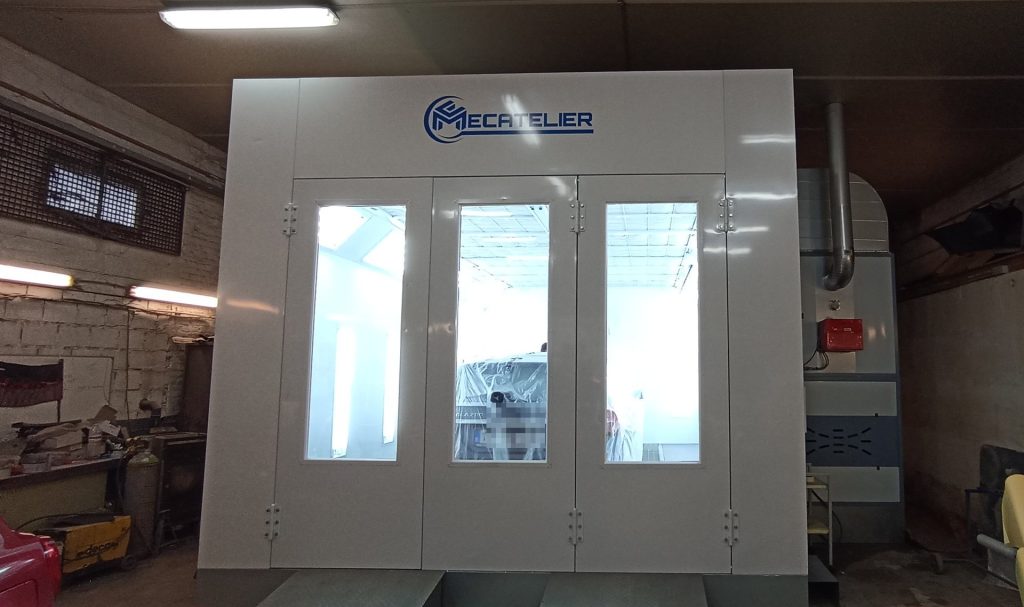
Professional car paint booth for body shops
Three sizes, from €26,900 excl. VAT, delivery and installation included. From the independent repairer setting up to the franchised dealership.
You’re looking for a car paint booth — also called an automotive paint booth, a spray booth or a paint room — that gives a clean finish first time, doesn’t send your gas bill through the roof, and lasts twenty years.
Our Evolutive range goes from the independent repairer starting out on a tight budget up to the franchised dealership. Three sizes, two control levels, and the option of upgrading your booth years after it has been installed.
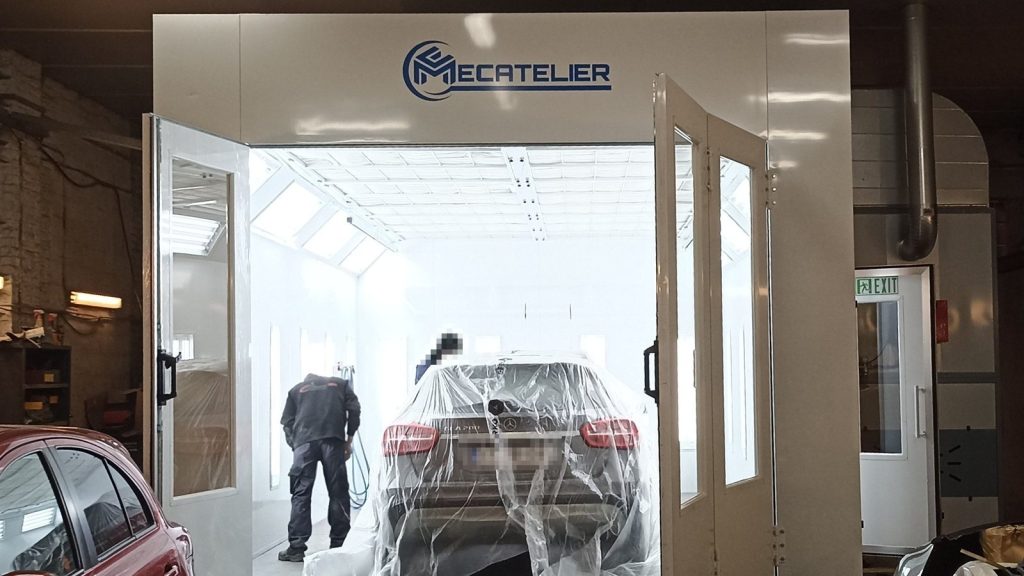
Body shop paint booth: the models and their prices
Three sizes, three indicative prices. Delivery and installation included in all three cases.
Passenger cars. The size that covers a body shop’s day-to-day work.
Cars and standard vans. The choice for shops that regularly take in vans.
Large vans and high-roof vans. When the height of the vehicle is what decides.
Prefer to install the booth yourself? That’s possible: from €20,900 excl. VAT, delivery included.
Usable dimensions, inside the booth — the width is 4 m on all three models. Indicative prices excluding tax: travel costs may be added depending on the distance, and the configuration chosen affects the price.
What’s included, and what isn’t
Only two items remain price on request, and for a reason: nobody can price them without having visited.
- ✓The booth
- ✓Delivery
- ✓Installation by our teams — you don’t receive pallets to sort out yourself
- •The duct that discharges the air outside
- •Floor work, if any
Travel costs are added depending on the distance.
Prefer to install it yourself?
It’s possible on the car range, and it brings the bill down. Many tradespeople setting up on their own choose this option to stay within budget. Let us know, and we’ll price both.
Financing
A lease with purchase option is available, with no mandatory down payment, based on your last two balance sheets. We state the capital amount; the finance provider states the monthly payment.
What it costs to run
Everyone asks about the purchase price. What really decides is what comes afterwards.
If the model is in stock. We tell you when you order, not afterwards.
If it has to be built. You’re told as soon as you order.
Removing the old booth and installing the new one. That’s the real hidden cost of a replacement, and we prefer to say so up front.
When a booth stops, the workshop stops with it.
Heating
This is the big cost item, by far. The burner only runs at full power while it brings the booth up to temperature: after that it modulates, and when drying, part of the air is recirculated instead of being thrown outside.
Maintenance
It depends on your hours of use, not the calendar. We price it on your actual use rather than selling you a package that doesn’t match anything.
Why the range is called Evolutive
Size is a final choice. The rest isn’t — and the two aren’t linked.
The number refers to the size, and only the size. The control level is a separate axis, available on all three. At entry level, a push-button panel: the essential functions, nothing more, and a price that lets a tradesperson set up in business. At the top of the range, a set of electronic sensors that controls the booth, manages energy more finely and gives you a far more comfortable interface.
What it changes in your workshop
The air comes down from the ceiling to the floor. Everything else follows from that.
A clean finish first time
The air comes down from the ceiling to the floor, so the dust you stir up goes down under your feet instead of sticking to the bodywork.
Fast drying
Drying mode, or curing, brings the booth up to temperature and holds it there; the vehicle comes out sooner and the booth is free again.
A workstation you can breathe in
The air is renewed while you spray, and the solvents are removed as you go.
A heating bill kept under control
It’s the heating that costs money, not the fans. So that’s where your running budget is decided.
Car paint booth: our installations in body shops
Where the booth sits, how it is lit, what an Evolutive 8 is, and what can be added to it. In that order.
All the photos below are booths that we built, delivered and installed. They are among the 160 car booths we have installed.
Set on the existing slab, no civil works
Your floor stays as it is. The booth sits on top of it, and two ramps make up the height of the threshold: no excavation, no slab to redo.
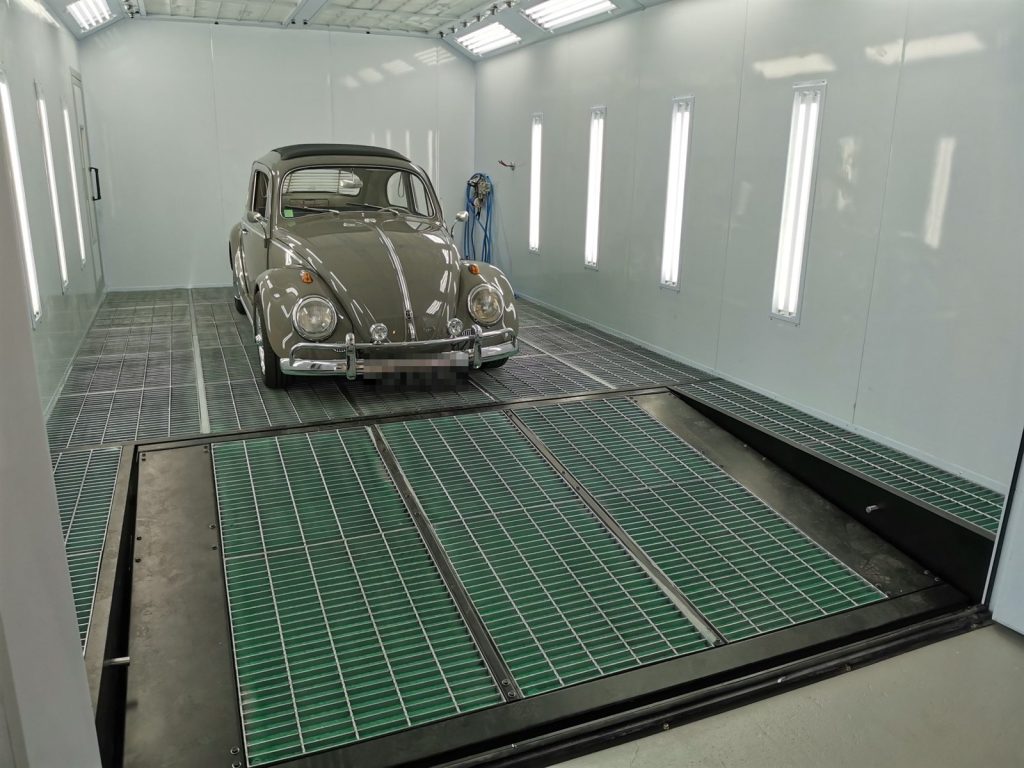
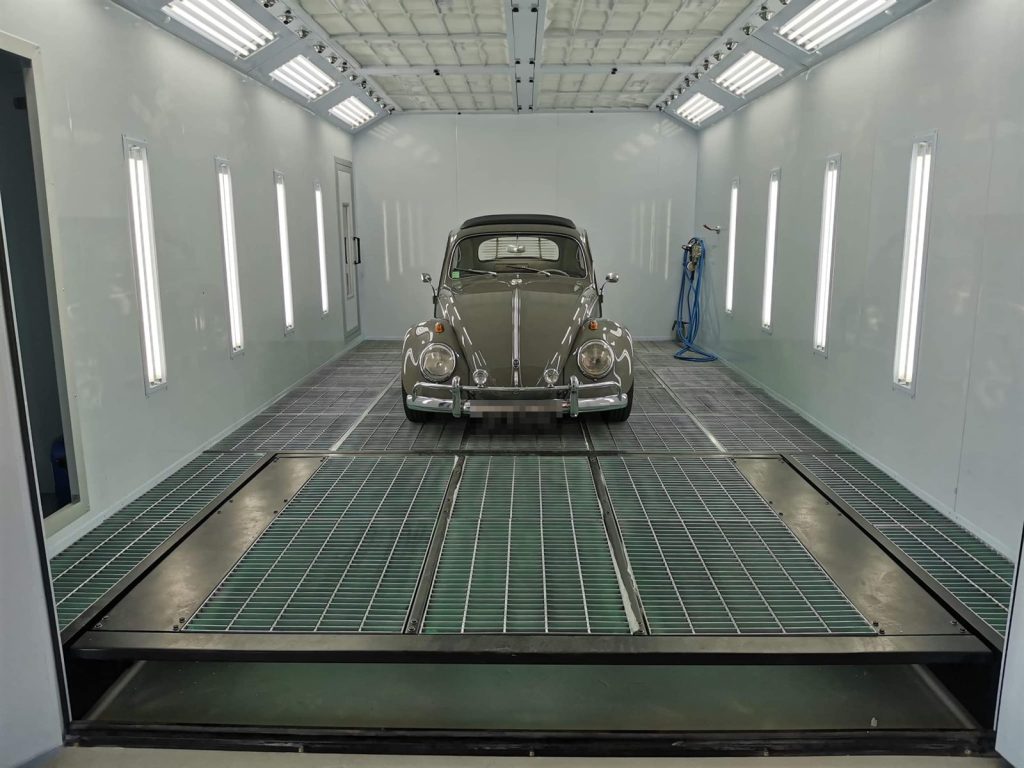
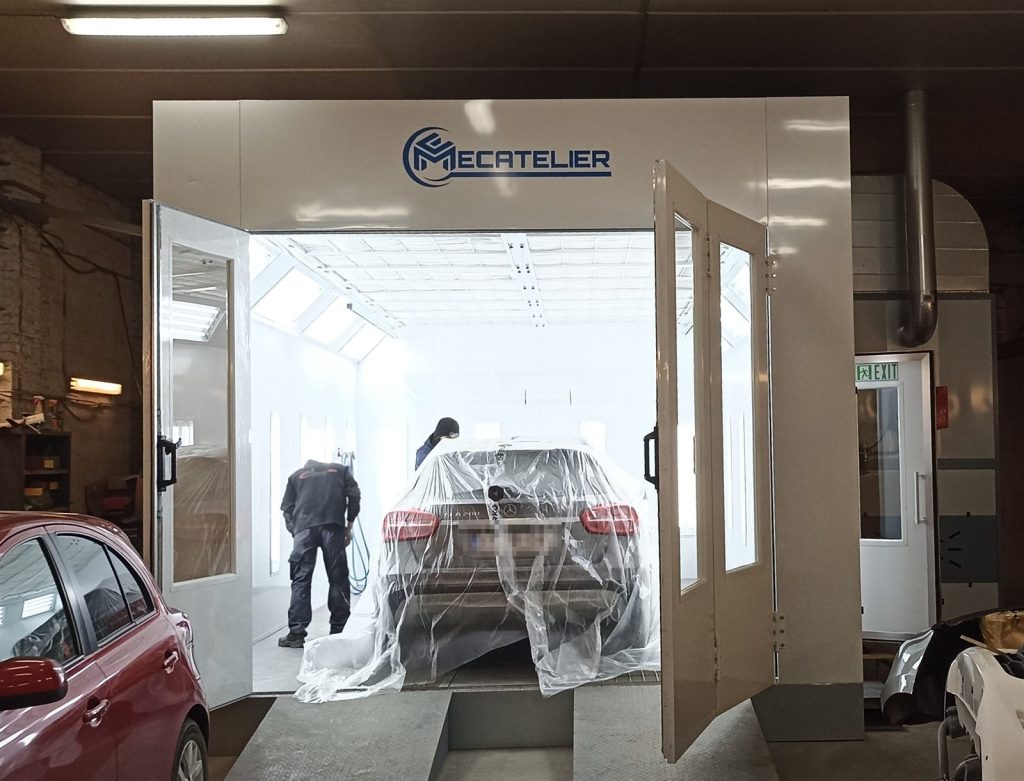
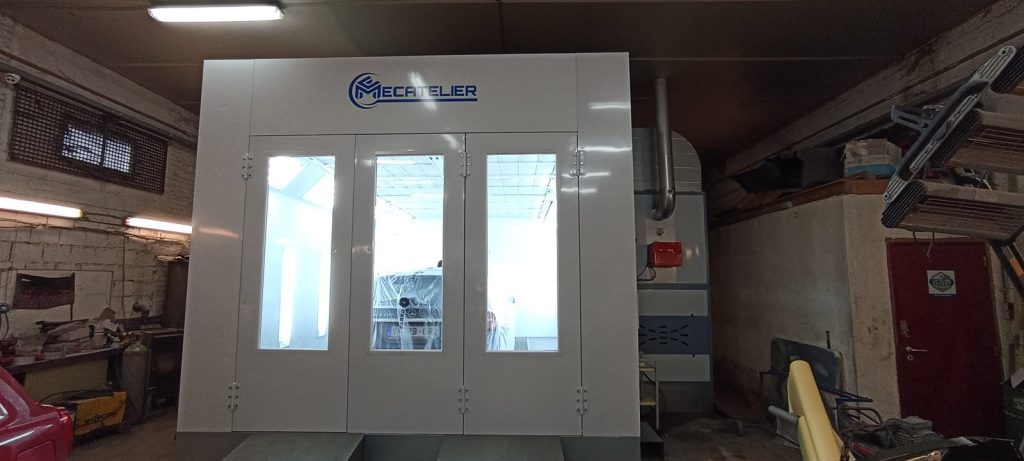
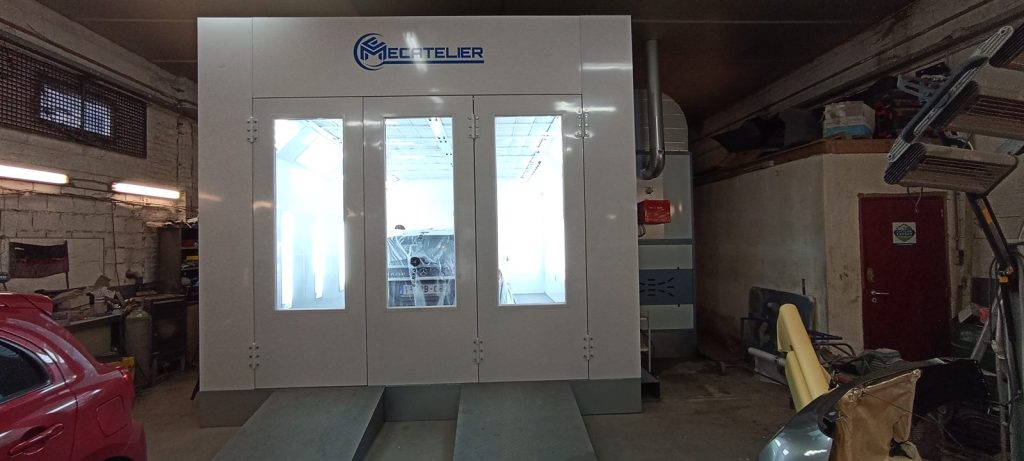
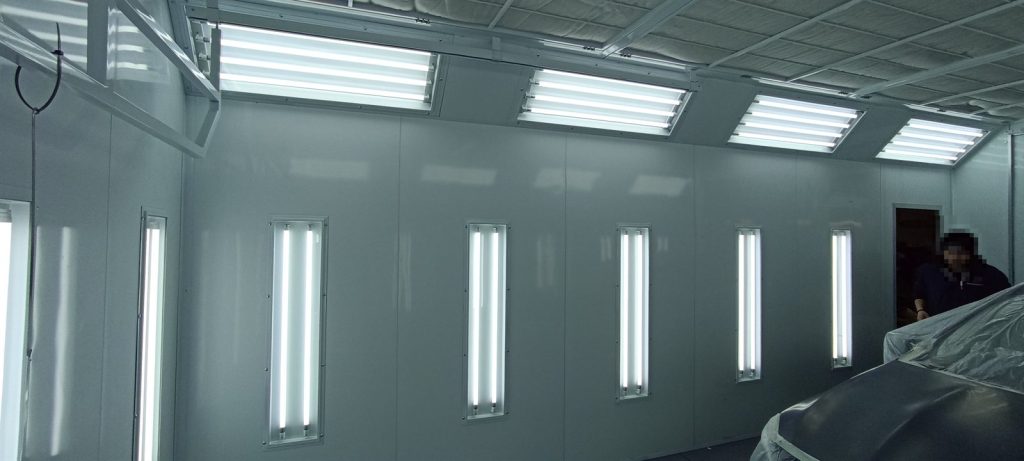
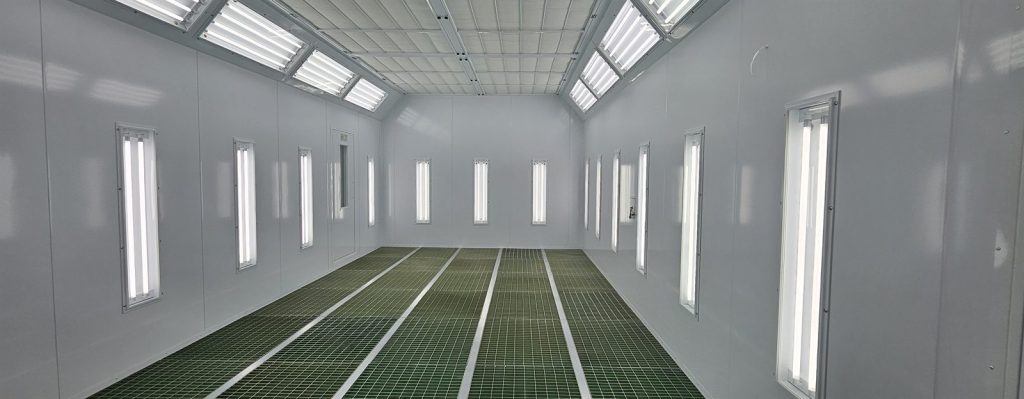
Light all the way round the vehicle
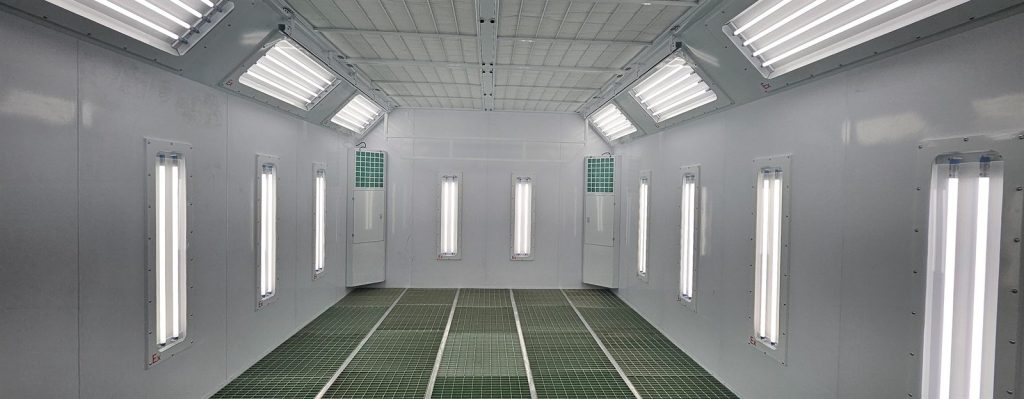
LEDs in the ceiling and light strips over the full height of the walls: the whole vehicle is lit all the way round, sills included. On the installation below, in an ATEX version.
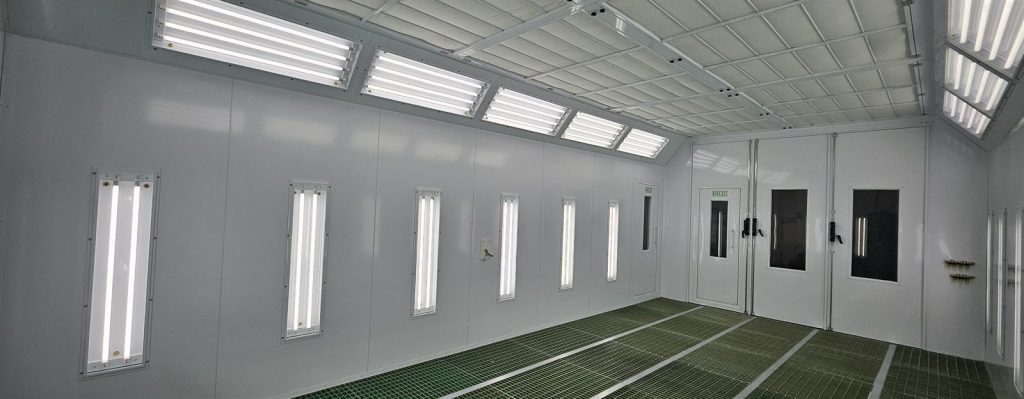
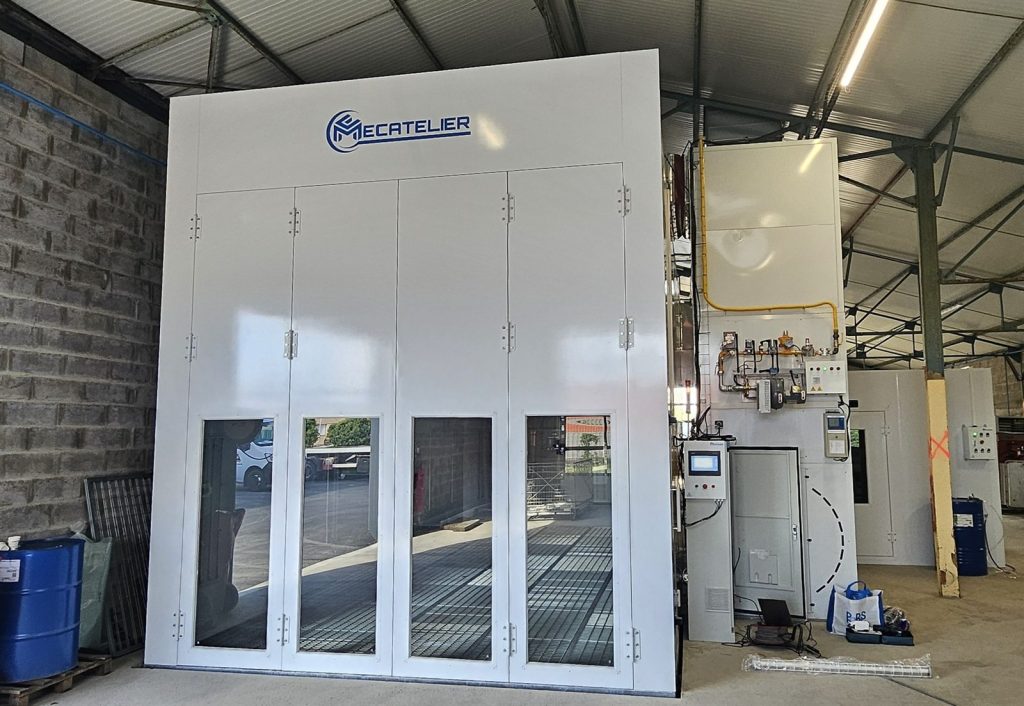
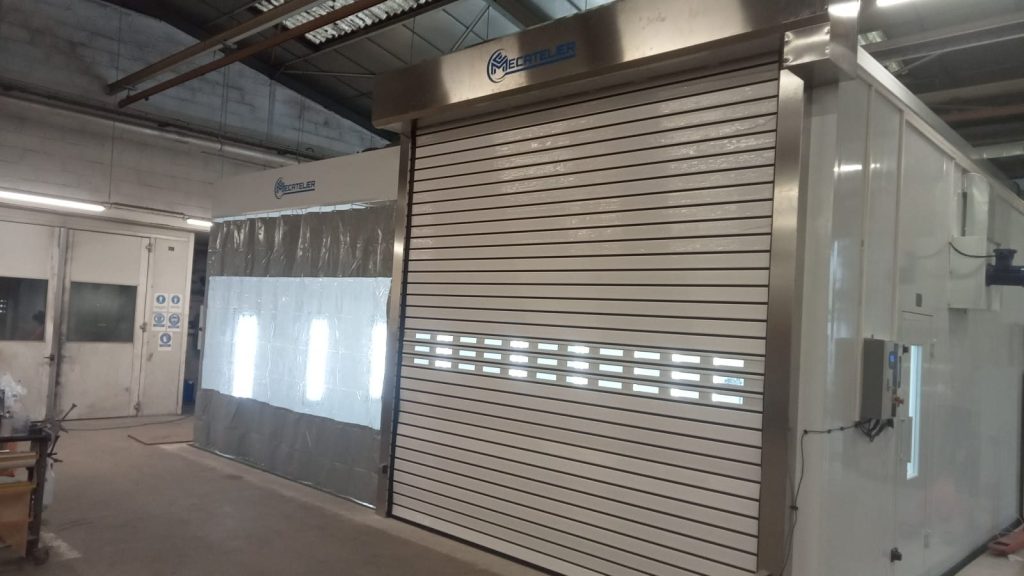
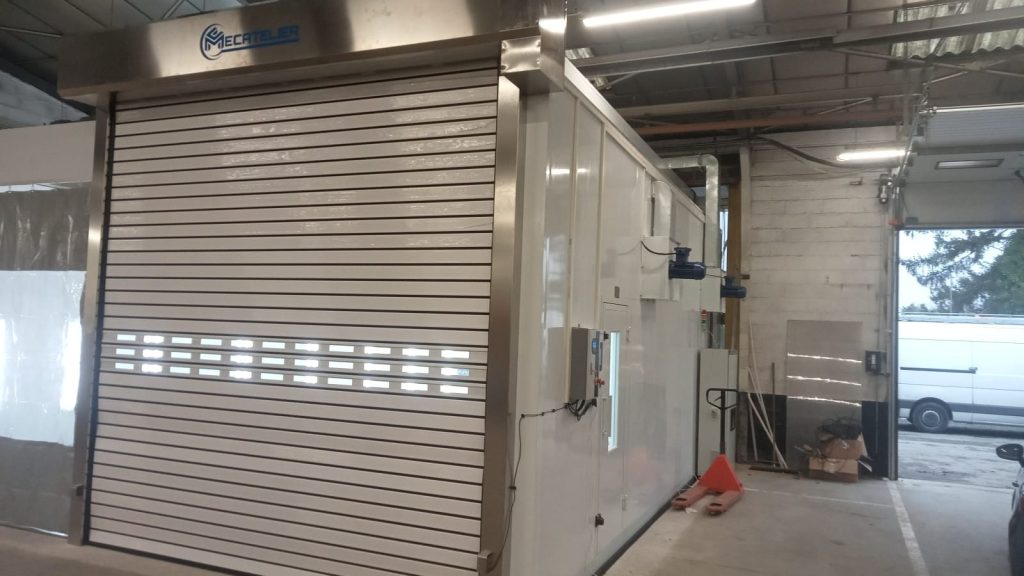
Evolutive 8: the van version, with a roller shutter
A roller shutter doesn’t swing out into the aisle. When the booth is against a wall or people need to pass in front of it to get elsewhere, that’s what decides whether the layout works.
Two options that fit across the whole range
They’re not reserved for cars or for vans: they’re added to whichever booth you choose.
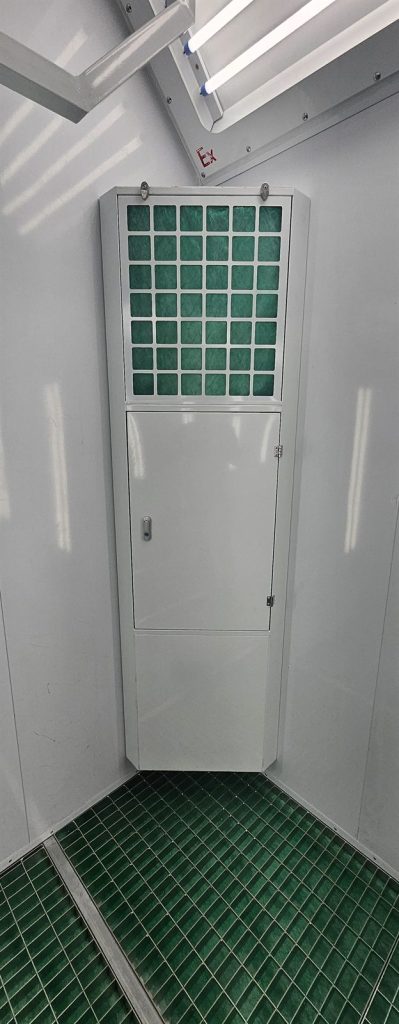
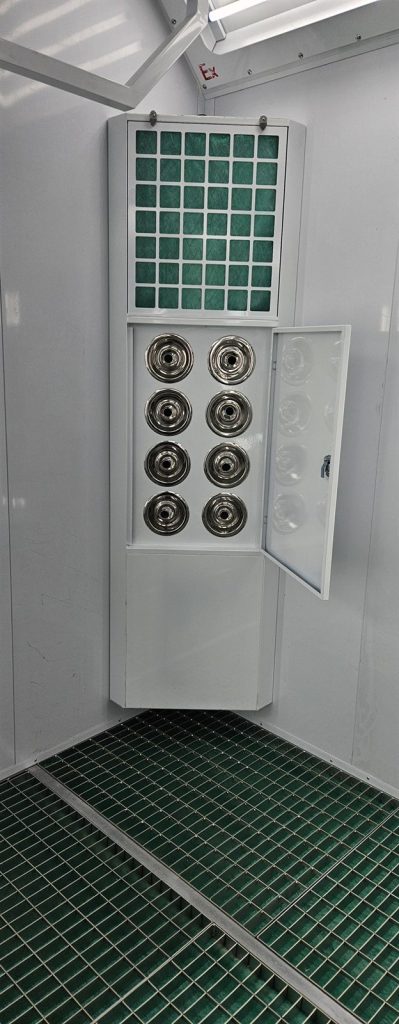
Accelerated drying for waterborne paints
An air blower module in the corner: eight nozzles blowing onto the bodywork. It also dries 2K clearcoats. The vehicle doesn’t leave the booth. It’s an energy-saving option.
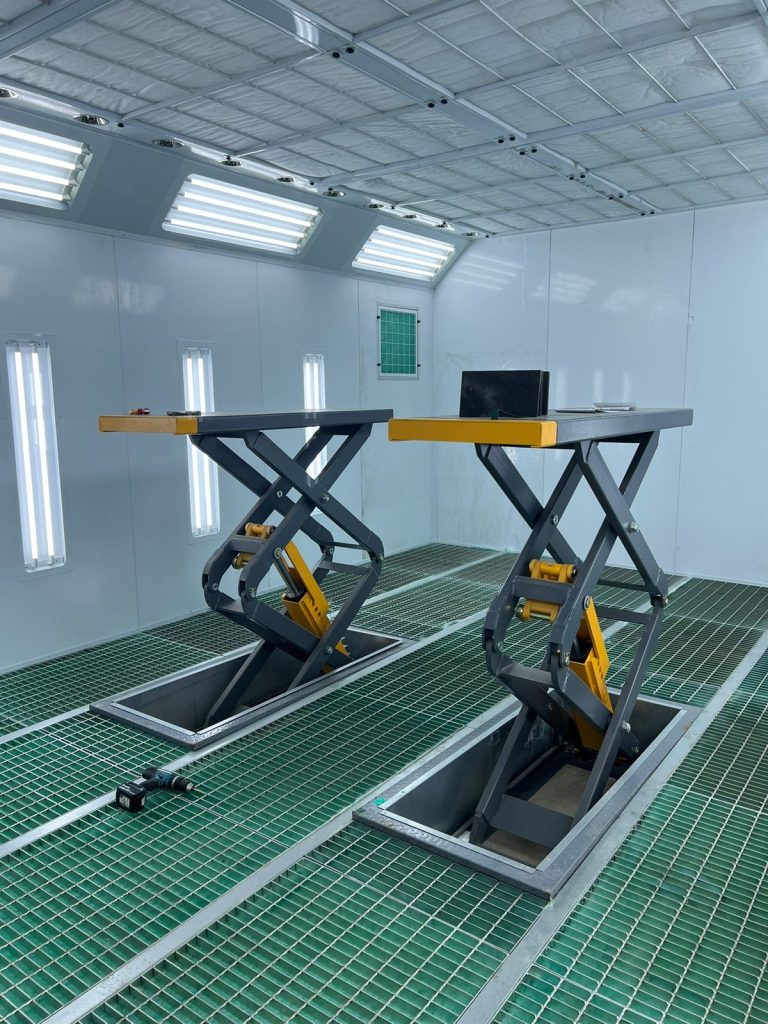
Scissor lift
Recessed into the grating floor: you work on the sills at the right height.
The figures are grouped in the FAQ, further down this page.
These fifteen photos show installations we have delivered. Yours depends on the space you have and what you paint.
Ventilation and airflow: comparing two quotes without getting caught out
Every manufacturer quotes an airflow. The figure looks comparable. It almost never is.
Each one calculates it on a different basis — and you pay for the difference later in finish quality. Three questions to ask, the same ones to everybody. If a salesperson dodges any of the three, you’ll know why.
‘What floor area is this airflow calculated on?’
Empty booth or vehicle inside, it’s not the same figure. Some offers look cheaper simply because they count a smaller area.
‘Is that the fan’s airflow, or the one I’ll actually get?’
With filters that are starting to clog, the second one drops. That’s the one that matters to you.
‘And in the corners?’
A booth can show a good average and deliver too little air in one corner. That’s where the dust settles — and that’s exactly what the standard forbids.
The full calculation, with the value required by the standard and the step-by-step working, is set out plainly in the question ‘What airflow is needed?’ in the FAQ, further down. Enough to check any quote, including ours.
Heating, drying and oven: where the money goes
Same equipment, two ways of running it — and completely different consumption.
While you’re painting
The booth discharges all the air outside — that’s what protects you. So it is constantly heating cold air drawn in from outside. This is the item that weighs on your bill, by far.
When drying, the booth acts as an oven
Part of the air is recirculated instead of being thrown away. You’re no longer heating the street. The vehicle comes out sooner and the booth is free again.
If you run cycle after cycle all week, heat recovery pays for itself. It costs more to buy and less every month. We’ll tell you frankly whether your throughput justifies it.
Filters, and why your finish depends on them
Three barriers between the dust and your bodywork. The one in the ceiling is the only one that shows on the result.
At the air intake
Stops the coarse dust before it wears out the fine filter. It’s the cheapest of the three, and it protects the other two.
In the ceiling
This is the one that decides your finish. When it reaches the end of its life, it shows on the car before it shows on a gauge. Don’t wait for that.
In the floor
Catches the paint mist before it goes into the duct. It saves you clogging up the fan and the extraction.
As standard, we fit what a body shop needs. If your end customer demands better — aerospace, cleanroom — we fit finer filters and adapt the motors accordingly. We’ve done it before.
Dimensions and layout: will it fit in your workshop?
Four things decide, and none of them can be guessed from an office. We always come and measure before pricing.
The dimensions given above are internal. You need to add the thickness of the structure and room to move around it: take them as a minimum, not as the final footprint.
Your ceiling height
There needs to be room above the booth for the air handling equipment. It’s the most common sticking point, and it’s the first thing we measure.
Where the air goes out
How far do you have to go to discharge it outside? That route is the cost item nobody can price without having visited.
Your floor
Either we dig, or we set the booth on a raised floor and you have a small step at the entrance. The second option avoids any concrete work.
Your electricity supply
You need three-phase power. If you don’t have it, it has to be planned for, and it’s better to know straight away.
And if none of the three sizes fits in your workshop, we build one to measure.
It’s been our trade for more than ten years, and a good share of our 360 installations are not catalogue models. A difficult building is no reason to give up.
What you don’t have to deal with
You’ve got a workshop to run. Here’s what we take care of.
We measureAt your premises, and we draw up the layout.
We buildIn our own workshops.
We deliver and installIncluded in the price, unless you prefer to do it yourself.
We commissionAnd we train your team.
We come backMaintenance and filters, even if the booth isn’t one of ours.
We take over existing installationsUpgrades to current standards, dismantling, relocation of installations.
They trust us
References available on request.
Frequently asked questions
The detailed figures are here: enough to check a quote yourself, line by line.
Your question isn’t here?
It’s probably the right one. Ask it in one line, and we’ll answer in one line.
Ask my question →How much does a car paint booth cost?
From €26,900 excl. VAT for an Evolutive 6 (6 × 4 × 2.6 m), €28,900 for an Evolutive 7 and €36,900 for an Evolutive 8. Delivery and installation included in all three cases. The exhaust duct and any floor work remain price on request, because they depend on your building. Travel costs may be added depending on the distance.
Can I install the booth myself?
Yes, on the car range. Installation is included in the displayed prices, but if you prefer to do it yourself, that’s possible and it reduces the bill. It’s an option often chosen by tradespeople setting up on their own. Tell us when you request a quote, and we’ll price both.
What is the difference between entry level and top of the range?
The control system. The entry-level version has a push-button panel with the essential functions. The top-of-the-range version is fitted with electronic sensors that control the booth, manage energy more finely and offer a more comfortable interface. Size is a separate axis: each control level is available on all three sizes.
Can I upgrade my booth after installation?
Yes, and that’s what gives the Evolutive range its name. A booth bought at entry level can take the top-of-the-range options several years after installation, for about one day on site. You start with the budget you have and add equipment when your business allows.
How much does a paint booth consume?
At full power, the burner uses about 21 m³/h of natural gas, or 17 kg/h of heating oil. But it only runs at full power while it brings the booth up to temperature: after that, it modulates. When drying, part of the air is recirculated instead of being discharged, which cuts consumption sharply. So the real cost depends mainly on how many cycles you run back to back.
What airflow is needed for a car paint booth?
For a 6 × 4 m booth, allow about 26,000 m³/h. The full calculation, if you want to check a quote yourself: the NF EN 16985 standard requires an average air velocity of 0.30 m/s, and never less than 0.25 m/s at any given point. You multiply the floor area by this velocity, then by 3,600 — i.e. 24 m² × 0.30 × 3,600 = 25,920 m³/h. The trap, when you compare two offers, is that each one may use a different reference area.
Which filters for body shop work?
What we fit as standard is right for car bodywork — in technical terms, G4 at the air intake and F5 in the ceiling. If you work for a more demanding customer, we fit finer filters and adapt the motor power to compensate. We have already gone as far as F10 on an aerospace project.
What lighting in a car paint booth?
Lighting is judged on two things: the amount of light and its colour rendering. A colour checked under poor lighting turns out wrong when the vehicle comes out into daylight. Our booths are lit from the ceiling and the sides to eliminate shadows along the flanks of the vehicle, which are the hardest areas to check. We adapt the number of light units to the size of the booth and your type of work.
How long will my workshop be out of action?
Allow 5 to 10 working days to remove the old installation and install the new one. As for lead time, if the model is in stock it arrives within 2 to 3 weeks; if it has to be built, allow 3 to 4 months. We tell you the lead time when you order.
Do I have to break up my workshop floor?
Not necessarily. Either we dig a pit, or we set the booth on a raised floor — in that case you have a small step at the entrance, and no concrete work at all. The on-site survey decides. That’s also why this item remains price on request: it would be dishonest to announce it in advance.
And what if none of the three models fits in my workshop?
We build one to measure. A good share of our 360 installations are not catalogue models: awkwardly shaped premises, limited height, a column in the middle, restricted access. Send us your dimensions and your constraints, and we’ll tell you frankly what can be done. A difficult building is no reason to give up.
Can I talk to a body shop that already has one of your booths?
We don’t publish our clients’ contact details online; it isn’t done. However, if your project is similar to one of theirs, we ask for their agreement and put you in touch. Just ask — it’s often what convinces people most.
Do you work on a booth that isn’t one of yours?
Yes, and it’s a good part of our work: refurbishment, compliance upgrades, maintenance, relocation. For filters too, the make of your booth doesn’t matter.
How long does a booth last?
More than twenty years if it is maintained. Over a period like that, the difference in purchase price between two models often ends up weighing less than the difference in consumption between them. The warranty is one year, extendable up to seven years with a maintenance contract.
Let’s talk about your workshop
Tell us what you paint and how much ceiling height you have. We’ll tell you straight away whether it’s feasible, and at what price. No brochure, no sales follow-up.


