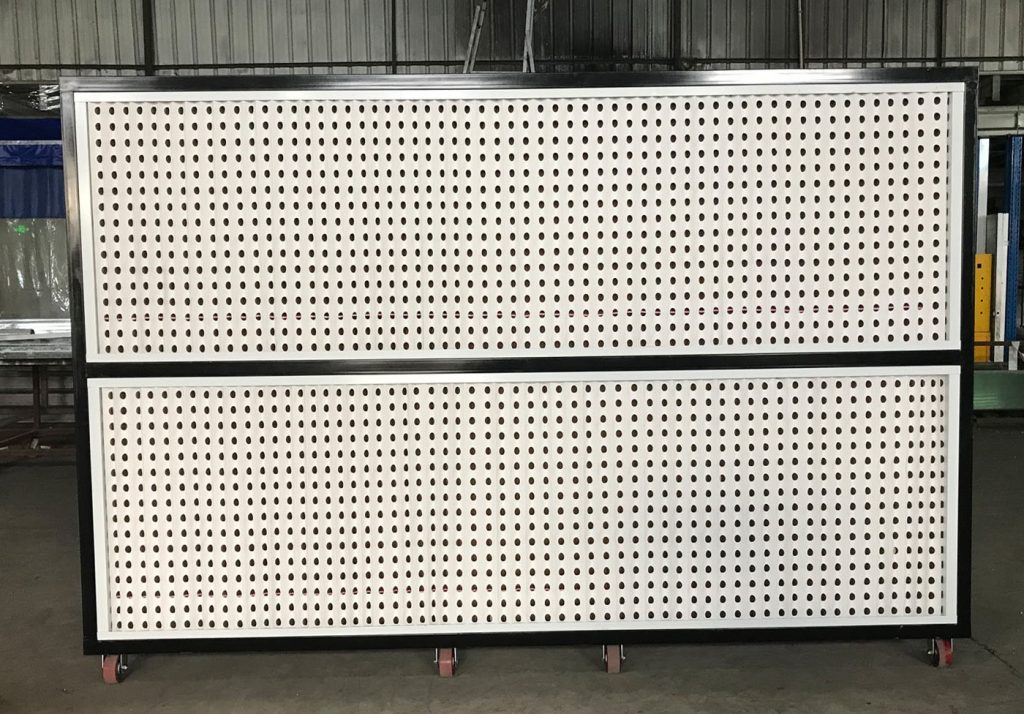
Filters and maintenance for paint booths
Filters decide your finish and your energy consumption. We supply and replace them, whatever the make of your booth.
A paint booth that extracts poorly does not break down: it deteriorates slowly, and the fault shows up in the finish before it shows up on a screen. Dust trapped in the film, mist that lingers, drying times that get longer, consumption that climbs — these are almost always symptoms of clogged filters.
We supply the filters and carry out the maintenance of paint booths, including those we did not build.
The four filtration stages
In a properly designed booth, the air is filtered four times. Each stage has a distinct role, and neglecting one of them shifts the load onto the next ones.
- Pre-filters, class G3, at the motor inlets: they hold back outside dust before it reaches the heat exchanger
- Ceiling filters, class F5: the last barrier before the air enters the working area — they are what decides how clean your finish is
- Floor filters, paint-stop type, or back-wall filters if the booth stands on the floor: they catch the paint-laden mist
- Extraction filtration, as the air passes the extraction motor, before discharge
Going beyond the standard
G3 / F5 / paint-stop is our default configuration, and it covers the vast majority of workshops. It is not a limit.
We install any filtration class on the market: it is the pressure delivered by the motors that is adapted accordingly, not the filter that is chosen to suit the motors. The distinction is not theoretical — fitting a finer filter without reviewing the ventilation means weakening extraction instead of improving cleanliness.
We have gone as far as F10 on an aerospace project. If your specification requires a particular class, it can be done: tell us which one and for what volume.
Extractor fan and ventilation
The extractor fan governs the booth’s overall performance. Its power must be calculated on the real extraction area — that is, with the vehicle or part in place, not with the booth empty.
An undersized extractor fan lets the mist linger: it is a quality problem, but above all a safety problem for the operator. A correctly sized but clogged extractor fan produces exactly the same symptoms, which explains why the motor often gets the blame when the fault lies with the filters.
We work on both: filter replacement, inspection and replacement of motors and fans, diagnosis of performance loss.
Calculating the ventilation airflow
The calculation fits on one line: airflow in m³/h = extraction area in m² × air speed in m/s × 3,600. All the difficulty lies in the two values you put into it.
The speed is given by the NF EN 16985 standard. In vertical flow — from ceiling to floor — it must reach at least 0.25 m/s at every measuring point, with an average equal to or greater than 0.3 m/s. In horizontal flow, 0.4 m/s minimum and a 0.5 m/s average.
The area is that of the cross-section the air passes through. For a vertical-flow booth, it is the floor area.
A concrete example. A 6 × 4 m body shop booth has 24 m² of floor area. At a 0.3 m/s average: 24 × 0.3 × 3,600 = 25,920 m³/h. That is the order of magnitude to expect from a unit correctly sized for this format.
And here is the trap, the one behind most disappointing installations: this calculation assumes the real extraction area, with the vehicle in place. Many manufacturer specifications are measured with the booth empty. As soon as a car is inside, the free cross-section shrinks and the stated airflow no longer matches what actually passes through the working area. Always ask what basis the value was calculated on.
Maintenance and diagnosis
We come out on request, with no commitment. For workshops that would rather not have to think about it, a maintenance contract can be set up: replacements are then scheduled according to your actual use, rather than triggered by a drop in performance that has already set in.
- Supply of filters for booths of all makes
- Replacement of motors, fans and extractor fans
- Diagnosis of extraction performance loss
- Inspection and refurbishment of existing installations
- Audit and compliance upgrade
- Booth installation, dismantling and relocation
- Maintenance contract on request
Home-made or second-hand booth: what you need to know
Many searches are about the extractor fan for a self-built or second-hand booth. Let’s be direct: this is not an area where approximation comes without consequences.
A paint booth brings together solvents, a heat source and an airflow. Sizing the extraction, the type of equipment used in a spraying atmosphere and the discharge conditions are all subject to precise regulatory requirements — for fire safety as well as occupational health.
We do not supply equipment intended for a makeshift installation. On the other hand, if you have taken over a second-hand booth and want to bring it back into compliance, that is a service we provide: audit, diagnosis and refurbishment.
Frequently asked questions
Which filtration classes do you use?
By default, G3 as pre-filter, F5 in the ceiling and paint-stop in the floor or back wall. This configuration covers the vast majority of workshops. Any other class on the market can still be installed: we then adapt the pressure delivered by the motors, which is the condition for a finer filter to genuinely improve cleanliness instead of restricting extraction.
Can you fit higher-class filters, such as F9 or F10?
Yes. We have gone up to F10 on an aerospace project. The constraint is not the filter but the ventilation that has to pass through it: it is the sizing of the motors that is reworked accordingly.
Do you supply filters for a booth that is not your make?
Yes. Give us the make, model and dimensions of your current filters, or a photo of the label, and we will identify the matching references.
How do you calculate the ventilation of a paint booth?
Airflow in m³/h = extraction area in m² × air speed in m/s × 3,600. The speed comes from the NF EN 16985 standard: in vertical flow, 0.25 m/s minimum at every point and a 0.3 m/s average. For a 6 × 4 m booth, i.e. 24 m² of floor area, that gives about 25,920 m³/h. Note: the area to use is what remains free with the vehicle in place, not with the booth empty.
What airflow pattern for a paint booth?
The principle is always the same: the air is filtered at the inlet, pushed by a supply motor through the ceiling filters, crosses the working area from top to bottom carrying the mist with it, then is captured at the floor or back wall before being extracted by a second motor. Two separate motors, four filtration stages, and a flow that never goes back up: it is this pattern that protects both the finish and the operator.
How often should the filters be changed?
It depends on your actual use: number of spraying hours, products used, how dusty the workshop is. The signs to watch for are weakening extraction, dust in the finish and consumption that rises while use stays the same.
Do you offer a maintenance contract?
Yes, on request. We also come out on a one-off basis, with no commitment. The contract has one simple benefit: it triggers replacements before the drop in performance becomes visible on your finishes.
How can I tell whether my extractor fan is undersized or simply clogged?
The symptoms are identical, which is what makes diagnosis difficult from the workshop floor. The starting point is always to replace the filters: if performance comes back, the motor was not the cause.
Do you work on site?
Yes, all over the world, for diagnosis as well as component replacement; our main markets are France, Belgium and Luxembourg.
Need filters or a diagnosis?
Tell us the make and model of your booth; we will identify the references and come out if needed.


