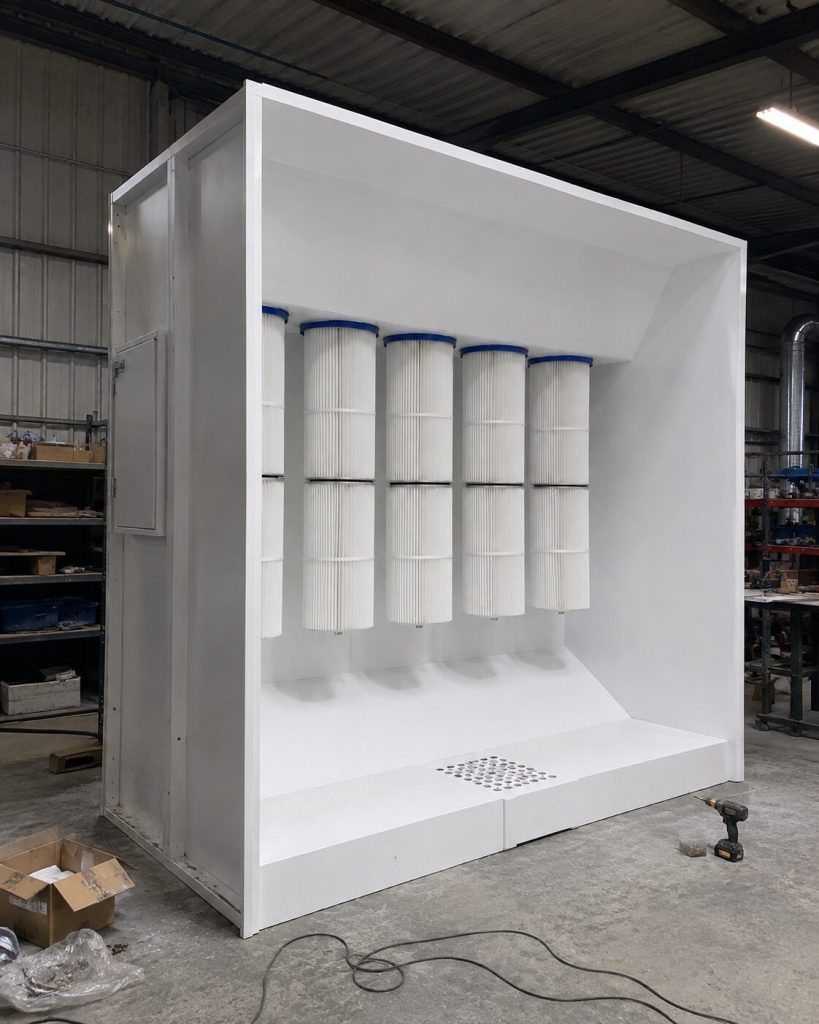
Industrial powder coating lines
Applying the powder is only half the job. Without controlled curing and without recovery, a powder coating installation costs more than it brings in.
Powder coating has two advantages that no liquid paint can match: no solvent, and the powder that has not stuck can be recovered and reused. A well-equipped workshop loses very little material.
But powder does not dry: it cures. So you need an enclosure that can bring the part up to temperature and hold it there, which an ordinary paint booth cannot do. It is this constraint that turns a powder coating station into an installation.
The three functions of an installation
Whatever its size, a powder coating installation does three things. They can fit into two enclosures or spread over a complete line, but none of them can be missing.
Application
a booth that captures the sprayed powder instead of letting it settle in the workshop, and sends it back to recovery
Curing
a heated enclosure that holds the temperature and time required by the powder’s technical data sheet. It is what makes the coating; below the cycle, the result is not a paler colour, it is a coating that does not hold
Transfer
carrying the parts from one station to the next without touching them. An uncured powder-coated part gets marked at the slightest contact
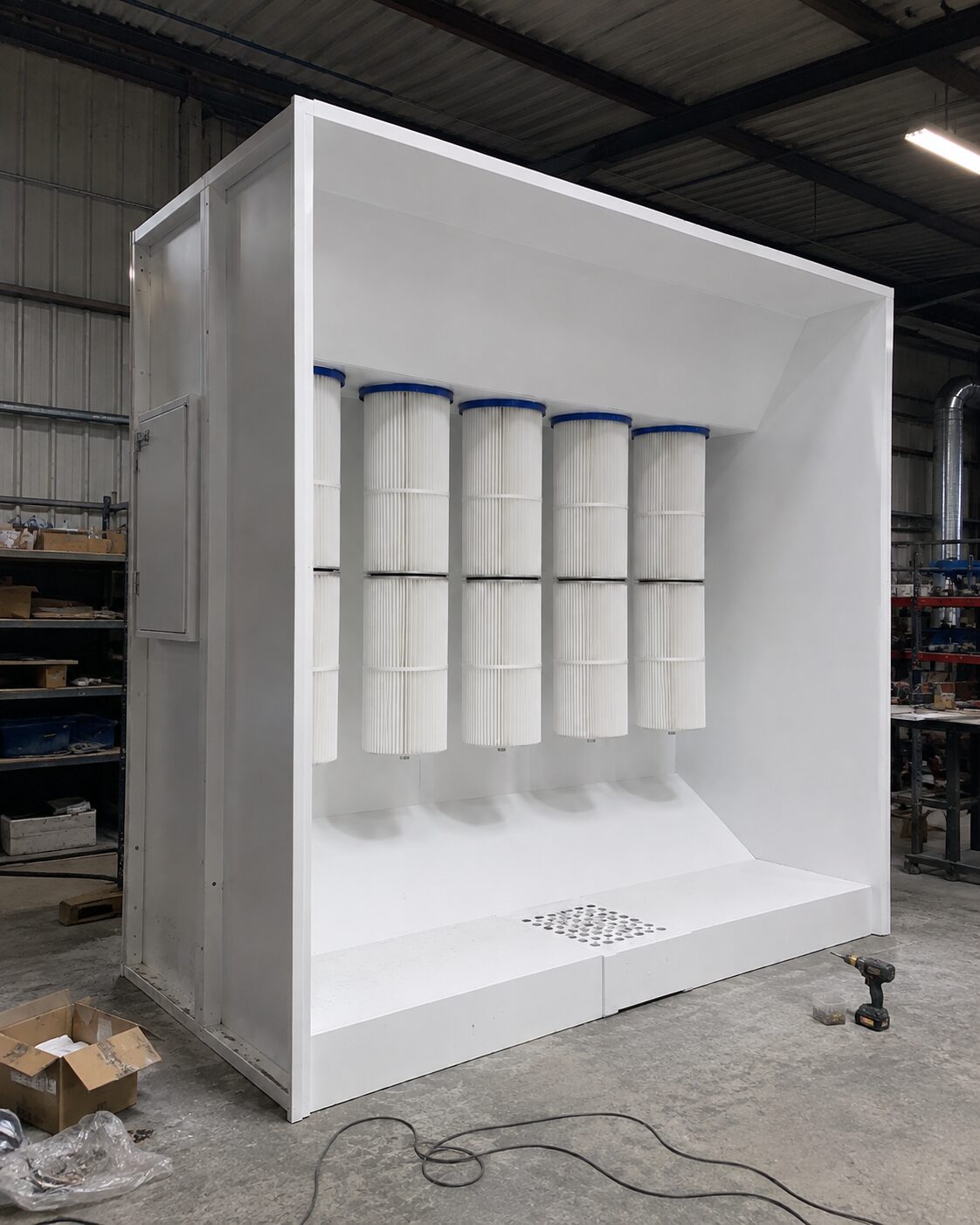
Powder that does not land on the part is material to recover
With liquid paint, the excess goes into the filters and is lost. With powder, it is still usable — provided the installation was designed to catch it.
That is the job of the cartridge filters and the hopper: the laden air passes through the cartridges, the powder falls back, and the booth’s geometry guides it to a single collection point. A booth without a slope or a collection point lets the powder build up in the corners, where it ends up being swept away.
That is also what makes colour changes realistic: a booth that is hard to clean forces you to keep the same colour, or to accept contamination.
Curing in the same enclosure, or in a separate oven
Two layouts, and the choice is made not on budget but on throughput.
A single enclosure that applies and then heats: it is the most compact and the cheapest option, and it is what a high-temperature curing booth makes possible. As long as volumes stay moderate, it is often the right answer — the enclosure only does one thing at a time, but it never waits.
A separate oven: the booth can coat the next part while the previous one is curing. This almost doubles capacity, at the cost of a second enclosure and a way of transferring the parts without touching them.
Frequently asked questions
What people ask us before getting into powder coating.
What is the difference from a powder coating booth on its own?
A booth applies the powder and recovers it: it is a station. A line adds curing and transfer, that is, everything needed to turn out a finished part without intermediate handling. If you are looking for the station on its own, see the industrial powder coating booths page.
At what temperature should the powder be cured?
The one given on your powder’s technical data sheet, and it varies from one product to another. That is why the study starts with the powder you use: it dictates the temperature, the time and therefore the sizing of the oven. An oven that does not reach the required cycle produces a coating that scratches and peels off.
Can you powder coat and spray liquid paint in the same workshop?
Yes, and it is common. The two processes need different enclosures — powder needs recovery and curing, liquid needs filtration and extraction — but they sit side by side very well in the same installation, each with its own station. Several of our projects combine both.
Do you need an automatic gun?
Not necessarily. Manual application works as long as the parts vary and runs are short; it often even gives the best result on complex shapes. Automation is justified on identical parts running through, where the movement is repetitive and the thickness has to be consistent.
How much space should you allow?
It depends first on your parts, then on the layout chosen. A single enclosure that applies and cures fits in an area comparable to that of a paint booth. A line with a separate oven needs room for both enclosures plus the transfer between them, which is often underestimated.
Is there a catalogue price?
No. The number of stations, the dimensions of the parts, the throughput and the building change the amount so much that a ballpark figure shown here would help no one. The study starts from your parts and your powder.
Already powder coating, or want to start?
Tell us what you treat, with which powder and at what rate. We will tell you whether a single enclosure is enough, or whether application and curing need to be separated.


