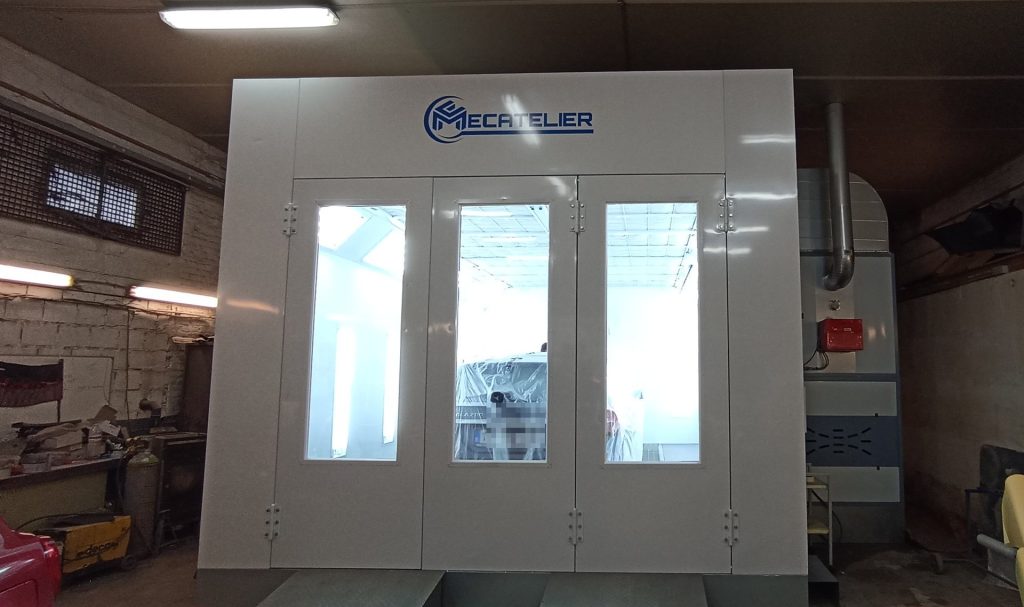
Paint booth audit and compliance upgrade
Your booth is ten years old. It works. That’s not the question — the question is what it is really still doing.
A booth doesn’t break down all at once. It deteriorates slowly: an airflow that drops year after year, a filter replaced a little late, a door that closes a little less well. Each gap taken on its own is negligible, and nobody adds them up.
The result shows first in the finishes and in the drying time, rarely on a warning light. That’s why a booth deserves to be looked at by someone for whom it isn’t an everyday tool.
What an audit looks at
The aim isn’t to draw up a list of complaints, but to separate what can be fixed in one visit from what calls for a decision.
Air renewal
this is the heart of the matter. A booth that no longer extracts enough no longer protects the operator properly and dries less well. It’s also what deteriorates most quietly
Filtration
condition, suitability and above all history. Clogged filters don’t just filter less: they restrict the airflow and unbalance the whole installation
Heating
combustion, control, the temperature actually reached compared with the one displayed
The booth shell
walls, sealing, doors and seals. A booth that leaks holds neither its temperature nor its pressure
Lighting
actual level in the work area. It’s the item people notice least and the one that costs the most in rework
Safety
emergency stops, doors that open from the inside, signage, consistency between actual use and what the booth was designed for
We also work on what we didn’t build
In fact, it’s the most frequent case. Our teams install our own booths and regularly dismantle those of other manufacturers — which is the best school for knowing what ages badly, and where.
So an audit doesn’t commit you to buying from us. A booth that needs filters and an adjustment doesn’t need replacing, and saying so is the only way to be believed on the day the answer is the opposite.
Repair, upgrade or replace
All three answers exist, and which one is right depends on the case. The audit is there precisely to choose on facts rather than on an impression.
Repair — filters, seals, settings, wear parts. That’s most cases, and it’s the cheapest.
Upgrade — redo the lighting, rework the extraction, change the control system. A sound booth with one outdated item gets brought up to date; it doesn’t get thrown away.
Replace — when the accumulated repairs approach the price of a new booth, or when the use has changed to the point that the booth no longer matches what is asked of it. It’s an investment decision, and it deserves a figure, not a feeling.
Frequently asked questions
What we are asked before having an installation looked at.
Is my installation compliant?
That can’t be answered from a website, and be wary of anyone who claims to without having visited. What applies to your workshop depends on your products, your volumes, your premises and your activity. The audit establishes the actual condition of the installation and identifies the gaps; the regulatory analysis that follows is done on the documents, not on a web page.
Does production have to stop during the audit?
Not entirely. Part of it is observed while the booth is running — this is in fact essential to assess air renewal and temperature rise. Another part requires the booth to be shut down. We organise the visit so that downtime stays short, and we let you know before we come.
Do you work on booths of other makes?
Yes, and it’s the most common case. Our teams regularly dismantle installations from other manufacturers, which gives practical knowledge of what ages badly depending on the design. The audit doesn’t depend on the original manufacturer.
What happens if everything is fine?
We tell you so, and that is an answer in its own right. An audit that concludes the installation is sound gives you a written basis for your next decisions, and a reference to compare against in two years’ time. That’s useful precisely because a booth deteriorates slowly.
Does the audit always lead to a quote?
No. It leads to a finding. If work comes out of it, we can price it, but most visits end with maintenance and adjustments — often things your own teams can do once they’ve been shown what to look at.
Have your installation inspected
Tell us what you have, how long you’ve had it, and what bothers you day to day. Longer drying times, dust in the finish, a smell in the workshop: those are the details that guide the visit.


